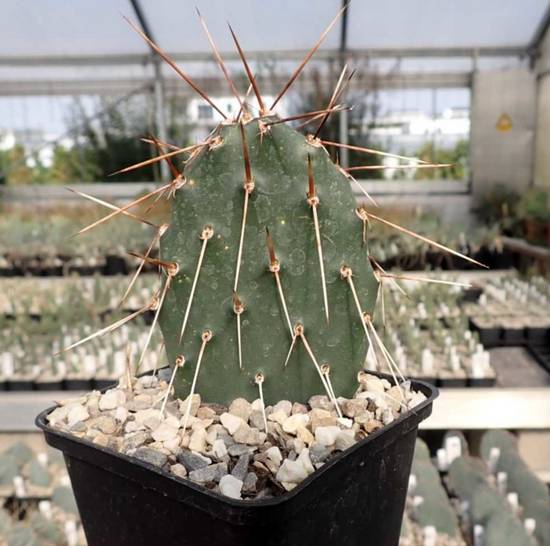
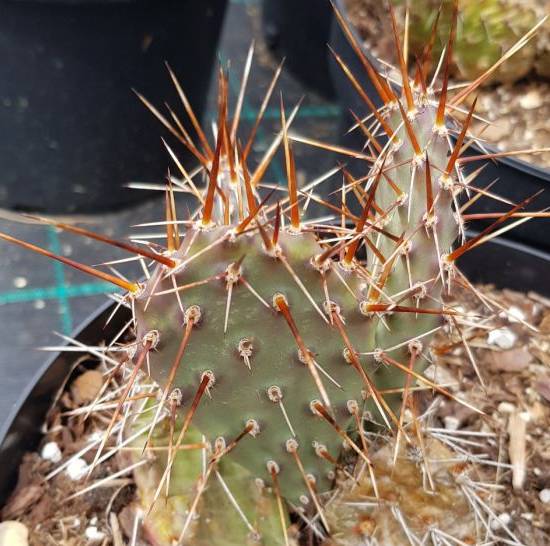
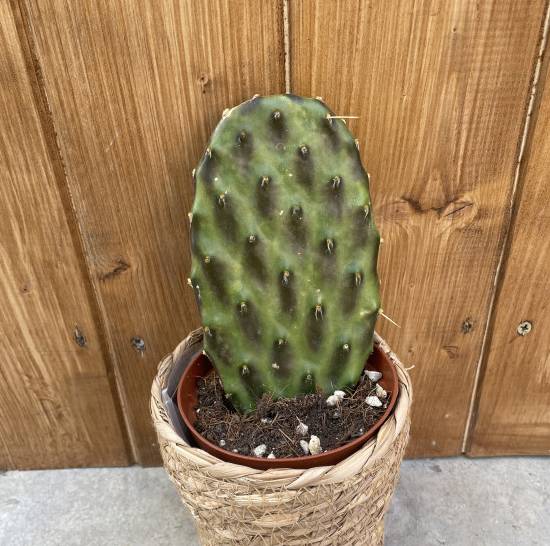
Opuntia Rhodantha Pisciformis
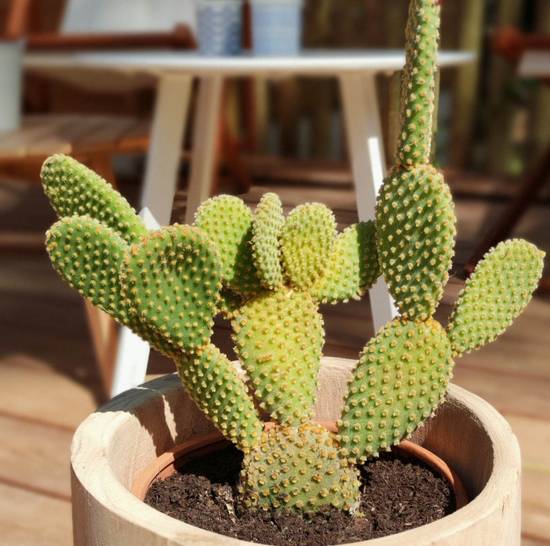
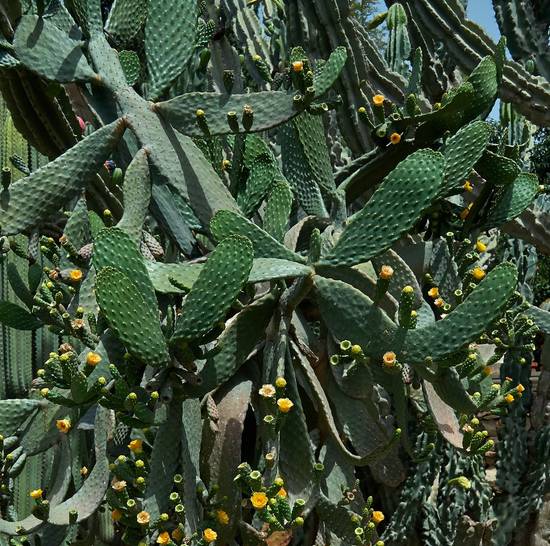
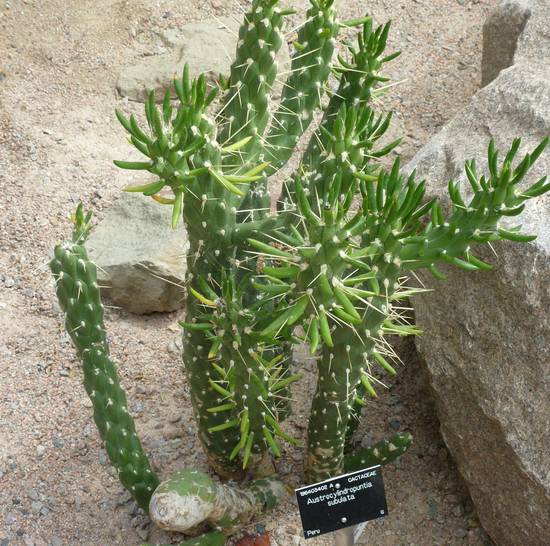
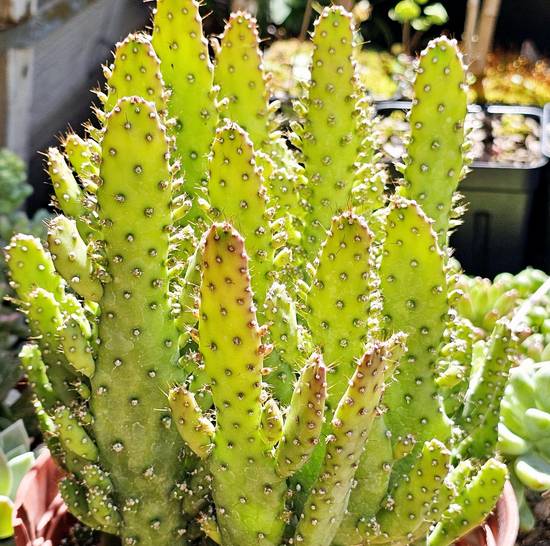
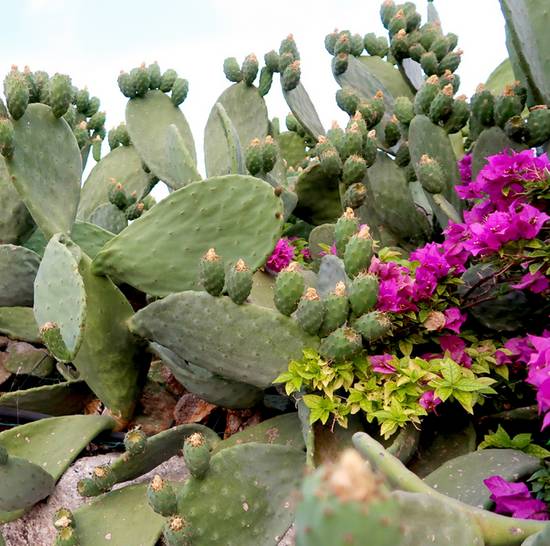
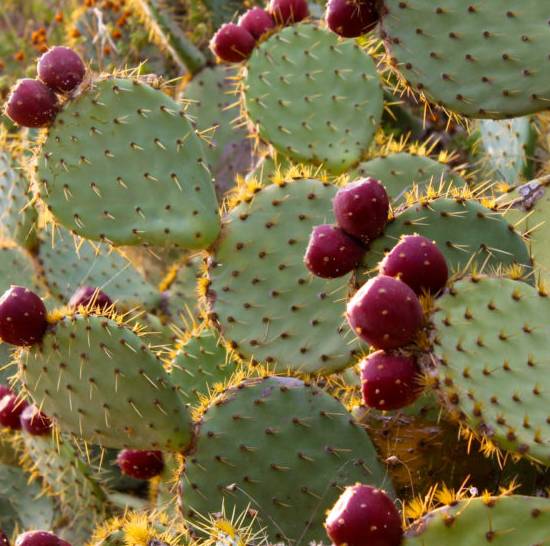
The Opuntia Rhodantha Pisciformis is a Mexican prickly pear with a low spreading habit, appreciated for its thick cladodes and upright spines creating strong graphic contrast in rock gardens. The pisciformis variety features more elongated segments and a slimmer silhouette than other forms, adding a contemporary rhythm to mineral scenes. In full sun and very draining soil, Opuntia Rhodantha Pisciformis quickly forms a dense cushion.
Growth is rapid when light, heat and drainage are optimal. It reacts to excess water with soft or elongated segments: better a thorough watering followed by complete drying than residual moisture.
Native to semi-arid plateaus of north-central Mexico, Opuntia Rhodantha Pisciformis grows on rocky outcrops and gravel slopes with brief rains and rapid drying.
To keep thick pads and compact habit, Opuntia Rhodantha Pisciformis requires full sun.
🌞 Ideal: 6–8 h/day; acclimate after winter.
🏠 Indoors: very bright south exposure or well-ventilated cold greenhouse.
🌞 Ideal: 6–8 h/day; acclimate after winter.
🏠 Indoors: very bright south exposure or well-ventilated cold greenhouse.
Adapted to rare rains, Opuntia Rhodantha Pisciformis prefers thorough but spaced watering on fully dry mix.
🌱 Spring/Summer: every 3–4 weeks in pots if totally dry; little water in ground after establishment.
🍂 Winter: almost dry; cold moisture is the main enemy.
🌱 Spring/Summer: every 3–4 weeks in pots if totally dry; little water in ground after establishment.
🍂 Winter: almost dry; cold moisture is the main enemy.
Built for dry heat, Opuntia Rhodantha Pisciformis tolerates brief drops when dry but fears damp cold.
🌡️ Ideal: 20–32 °C in warm season.
❄️ Minimum: about -8/-10 °C dry depending on strain; protect from winter rains.
🌡️ Ideal: 20–32 °C in warm season.
❄️ Minimum: about -8/-10 °C dry depending on strain; protect from winter rains.
To mimic its native screes, Opuntia Rhodantha Pisciformis requires a poor, ultra-draining mix.
🪨 Base: cactus soil strongly amended with minerals (sand/gravel) + added perlite and pozzolana top dressing at the collar.
🪨 Base: cactus soil strongly amended with minerals (sand/gravel) + added perlite and pozzolana top dressing at the collar.
When the cycle is respected, Opuntia Rhodantha Pisciformis lights up the rock garden with large diurnal blooms.
🌸 Period: late spring to early summer.
🎨 Colors: bright yellow with orange/reddish center; decorative red fruits.
🕑 Keys: full sun, dry winter rest, very moderate feeding.
🌸 Period: late spring to early summer.
🎨 Colors: bright yellow with orange/reddish center; decorative red fruits.
🕑 Keys: full sun, dry winter rest, very moderate feeding.
FAQ - Opuntia Rhodantha Pisciformis
How to identify Opuntia Rhodantha Pisciformis among other O. rhodantha forms?
More tapered segments, dense spines and spreading habit; a mineral setting with pumice mulch highlights these traits.
Which mineral display best enhances Opuntia Rhodantha Pisciformis?
Combine light gravel and dark stones, terracotta pot, and a very airy cactus potting soil for a clean display.
How to plant Opuntia Rhodantha Pisciformis in clay soil?
Create a raised gravel mound and drainage layer with drainage granules, avoiding any water stagnation at the crown.
What planting density in open ground for Opuntia Rhodantha Pisciformis?
Allow 60–80 cm between plants to anticipate spread; a mineralized cactus substrate helps establishment.
How to obtain fruits on Opuntia Rhodantha Pisciformis?
Provide full sun, a dry winter rest and encourage pollination; a very light application of succulent fertilizer during the season may help.
When and how to prune an oversized Opuntia Rhodantha Pisciformis?
Prune in late spring, remove excess pads, let callus 7 days then replant in draining mix; handle with gloves and newspaper.
Does Opuntia Rhodantha Pisciformis accept winter LED lighting?
Yes, 10–12 hours per day with ventilation; maintain an airy mineral-based cactus potting soil.
What specific mistakes should be avoided with Opuntia Rhodantha Pisciformis?
Avoid oversized pots, cold moisture and repeated feeding; prefer quick drying and a low-nitrogen cactus fertilizer.
How to treat mealybugs on Opuntia Rhodantha Pisciformis?
Use lukewarm showers, soft brushing and ventilation; keep the crown dry with a surface mineral mulch.
What propagation strategy should be adopted for Opuntia Rhodantha Pisciformis?
Pad cuttings to clone a plant, seeds for diversity; airy mix and low-dose liquid cactus fertilizer after establishment.