Euphorbia Polyacantha

Euphorbia Polyacantha

Euphorbia Polyacantha

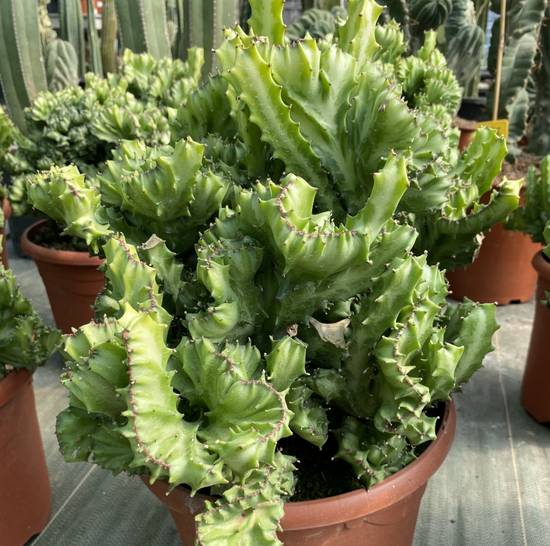
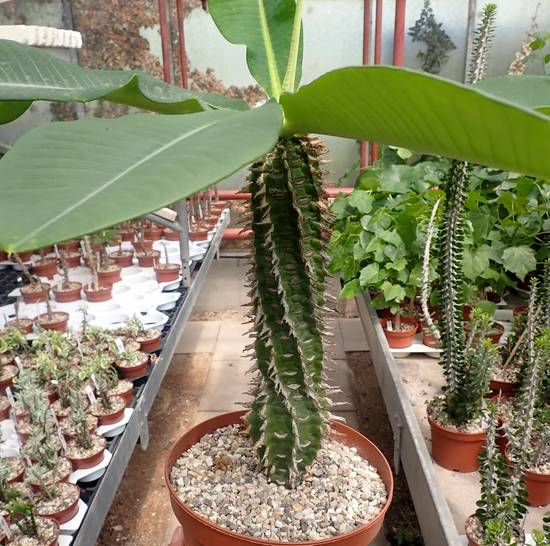
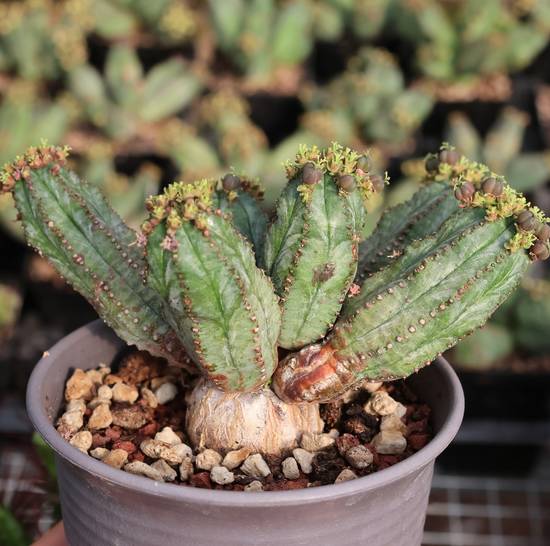
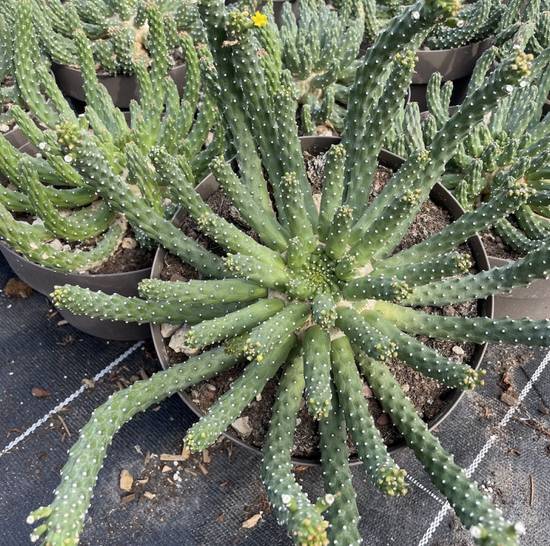
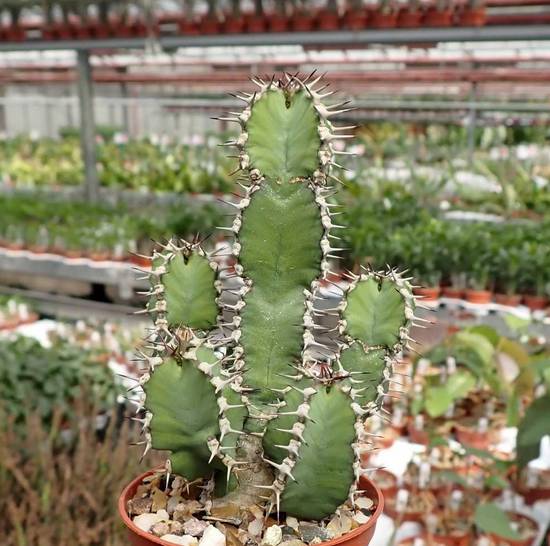
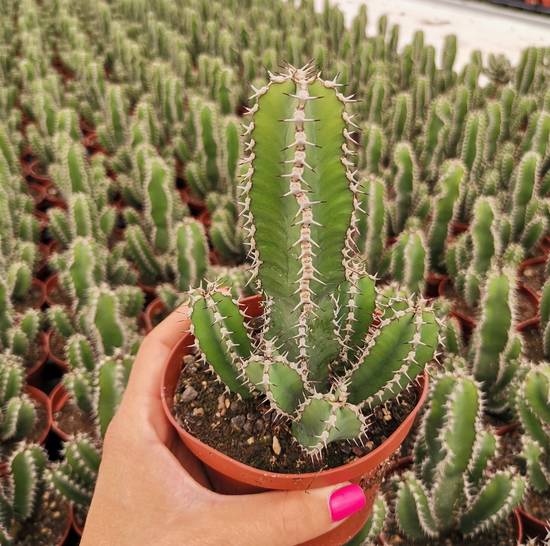
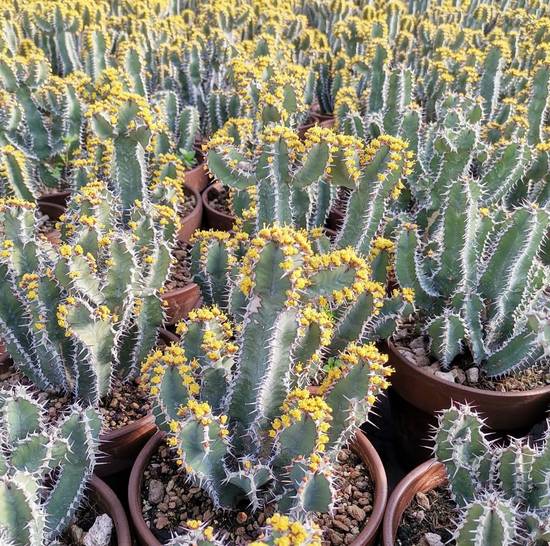
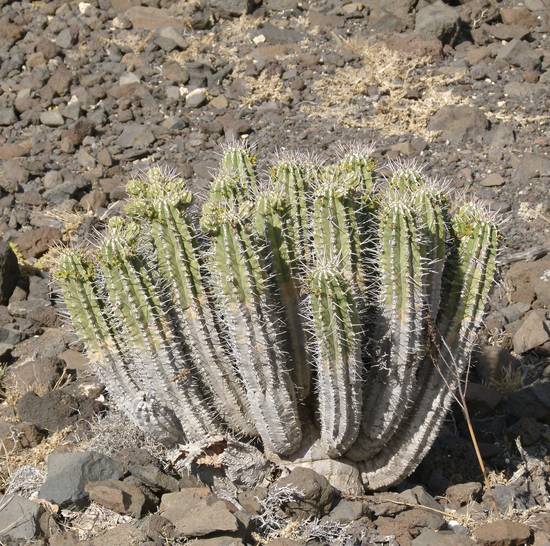
The Euphorbia Polyacantha is a surprising and graphic succulent plant, appreciated for its complex silhouette, wild appearance and numerous rigid spines. This small succulent shrub, native to the arid regions of southern Africa, forms dense clumps of upright and branched stems, giving it a very decorative bushy habit. The stems are grey-green, often marked with vertical striations, and lined with well-defined ribs from which many pairs of straight, long and sharp spines emerge.

Each stem of this Euphorbia resembles a miniature columnar cactus, but do not be mistaken: it is indeed a Euphorbia, with all the characteristics of this genus, notably the production of toxic white latex. In pots, it remains modest in size but can form beautiful colonies over the years. Resistant and undemanding, the Euphorbia Polyacantha captivates with its sculptural, raw and very natural look, reminiscent of desert landscapes.

In its natural habitat, the Euphorbia Polyacantha grows in semi-desert and rocky areas, on poor soils exposed to scorching sun. It has adapted to these extreme conditions thanks to its succulent stems capable of storing water, and to its spines which limit evaporation while discouraging herbivores.
Abundant light is essential for its development:

🌞 Direct sun or very bright light: It thrives in full sun. Place it outdoors in summer, or indoors in front of a south-facing window.

⚠️ Avoid prolonged shade: Too much shade will elongate the stems, weaken the plant and reduce spine production.
Watering must be very moderate:

💧 During the warm season: Water every 20 to 30 days, only when the substrate is completely dry.

❄️ In winter: Stop watering, especially if the temperature drops below 15 °C.

Tip: Too much water is the main cause of death. Be strict about drainage and frequency.
It is a heat-loving plant:

🌡️ Optimal temperatures: between 20 and 30 °C. It tolerates peaks above 40 °C if properly watered.

❄️ Minimum: Do not expose below 8 °C. In winter, it appreciates a dry rest around 10–15 °C.
🪨 The substrate must be perfectly draining to avoid any water retention:

Mix a cactus substrate at 50% with perlite. You can also add a thin layer of pumice stone on the surface for an aesthetic and draining effect
Flowering is discreet but typical of euphorbias:

🌸 Season: In spring or early summer, on young stems.

🎨 Appearance: Small yellow to green cyathia, arranged in pairs, often barely visible because of the spines.
FAQ - Euphorbia Polyacantha

What exposure suits Euphorbia Polyacantha?
Euphorbia Polyacantha loves direct sun. Place it in full sun or by a very bright window to keep its stems short and well-spined.
What type of substrate is suitable for Euphorbia Polyacantha?
A mix of cactus substrate and perlite, supplemented with pumice, will ensure perfect drainage.
How should Euphorbia Polyacantha be watered safely?
Always wait until the substrate is completely dry before watering. During the growing period, watering once a month is sufficient. In winter, do not water at all.
Is Euphorbia Polyacantha suitable for indoor cultivation?
Yes, provided it receives bright light and well-draining substrate. It is perfectly suited for very bright verandas or windowsills.
Can Euphorbia Polyacantha be propagated by cuttings?
Yes, stem cuttings can root if left to dry for several days before planting. Wear gloves due to the latex.
Can Euphorbia Polyacantha tolerate frost?
No, it does not tolerate freezing temperatures. Bring it indoors as soon as temperatures drop below 10 °C.
Is the sap of Euphorbia Polyacantha toxic?
Yes, like all euphorbias, it contains a latex that is irritating to the skin and eyes. Handle with care.
What maximum size can Euphorbia Polyacantha reach?
In a pot, it generally reaches 30 to 50 cm in height. In the ground under a warm climate, it can become much larger.
Why are the stems of my Euphorbia Polyacantha elongating without spines?
This is often a sign of insufficient light. Place it in a brighter location to encourage compact growth.
What fertilizer should be used for Euphorbia Polyacantha?
Add a little special cactus fertilizer in spring and summer, once a month at most, diluted in the watering water.