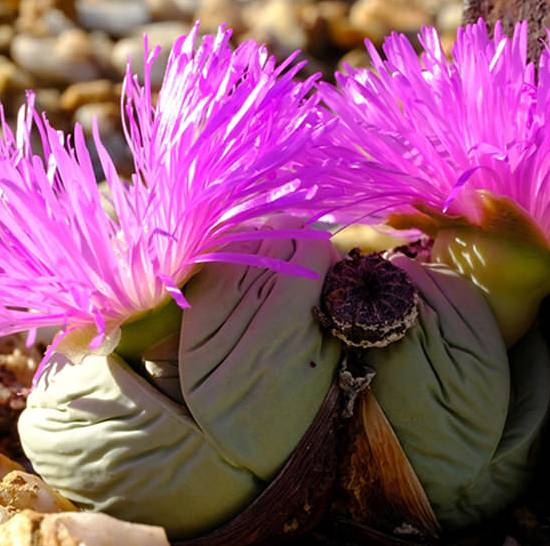
Argyroderma Pearsonii
The Argyroderma Pearsonii is a rare and particularly fascinating succulent, often classified among "living stones" due to its incredible ability to mimic the pebbles of its natural environment. Native to the arid regions of South Africa, this plant belongs to the Aizoaceae family and captivates as much with its minimalist aesthetic as with its remarkable adaptation to extreme conditions.
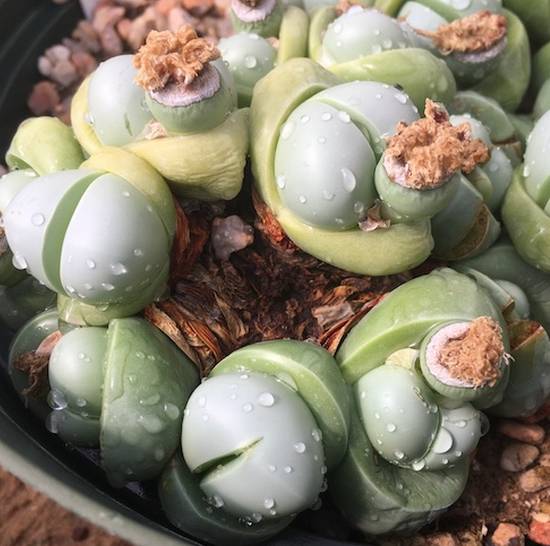
The Argyroderma Pearsonii generally consists of a pair of fleshy, thick leaves fused at their base, forming a compact and rounded structure. These leaves have a smooth texture and a color ranging from grey-green to silvery blue, sometimes covered with a slight waxy coating. This coloration allows it to reflect sunlight and limit evaporation, an essential mechanism for surviving in very dry environments.
Its mineral appearance is reinforced by its low and discreet shape, allowing it to blend perfectly into the rocky soils of its natural habitat. This camouflage strategy, called mimicry, protects the plant from herbivores by making it difficult to detect. In the wild, it is often difficult to distinguish an Argyroderma Pearsonii from a simple pebble.
It grows in very poor, sandy and rocky soils, where it blends with stones to avoid predators.
🌞 Bright light: direct sunlight recommended
🌤️ Indoor: near a well-exposed window
🌱 Growth period (autumn / winter): light watering
☀️ Dormancy (spring / summer): almost no watering
⚡ Warning: excess water = rapid rot
🌞 Ideal temperature: between 15°C and 25°C, with a preference for warm days and cooler nights, reproducing its natural habitat.
🌡️ Thermal amplitude: appreciates day/night temperature differences, promoting healthy growth and better coloration.
❄️ Minimum temperature: tolerates occasionally down to 5°C, but must absolutely be protected from frost and cold humidity.
🏠 Indoor cultivation: ideal in temperate climates, avoiding overheated rooms in winter to respect its dormancy period.
🪨 Key principle: zero prolonged water retention, water must drain immediately after watering.
🔬 Recommended mix: 20 to 30% special cactus soil (for a minimum of nutrients) + 40 to 50% perlite for aeration + 20 to 30% pouzzolane for drainage
🧱 Advanced alternative: possible cultivation in a nearly 100% mineral substrate (pouzzolane, coarse sand, gravel), ideal for experienced growers.
⚠️ To avoid: classic soils that are too rich and compact, which retain moisture and promote rot.
🌸 Period: mainly in autumn, at the end of the growth cycle
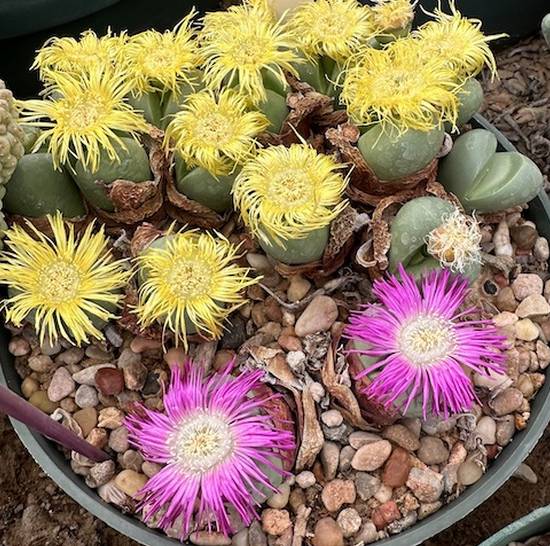
🎨 Color: bright pink to intense magenta, sometimes slightly purplish
🌼 Size: relatively large flower compared to the plant, sometimes almost completely covering the foliage
☀️ Behavior: diurnal flowers that open in full sun and close at the end of the day