Portulacaria Afra Mediopicta
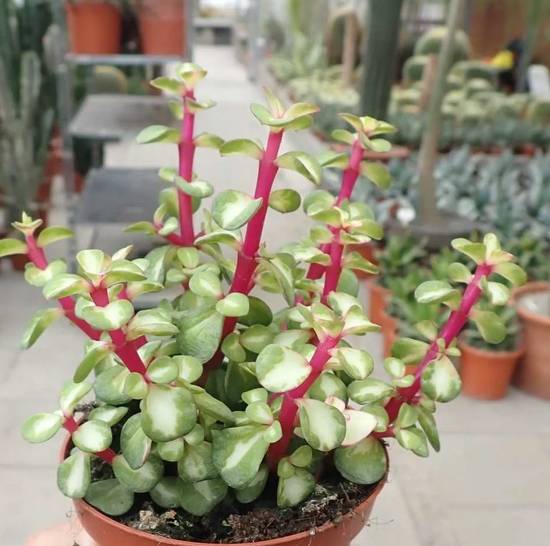
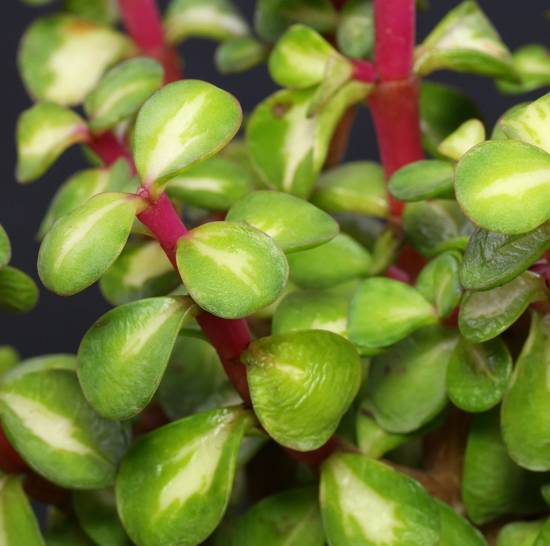
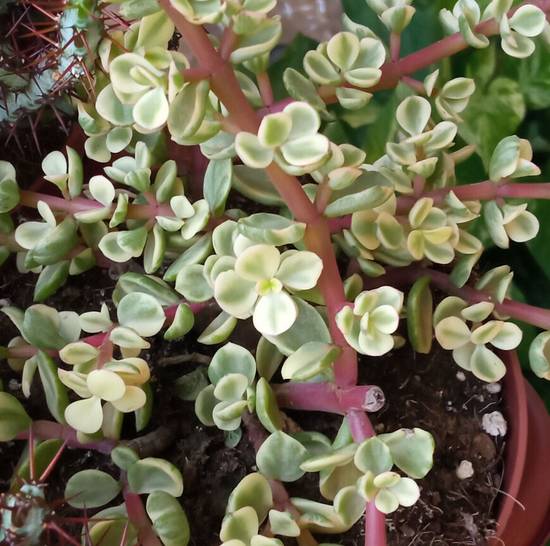
The Portulacaria Afra Mediopicta is a variegated and highly decorative form of the famous “elephant bush”. It is immediately distinguished by its small rounded to oval leaves, edged in dark green and marbled in the center with a cream to ivory stripe, giving a luminous appearance to the entire plant. Its compact and branched silhouette, combined with this bicolored foliage, makes it a choice ornamental succulent, suitable both indoors and outdoors in warm regions.
Highly appreciated for its rapid growth and ease of care, it is ideal for beginners as well as collectors. In pots, Portulacaria Afra Mediopicta can be pruned to form a small bonsai, a trailing clump, or a decorative ground cover. Its drought tolerance, heat resistance, and ability to store water in its stems make it a particularly robust plant.
Native to southern Africa, this variety has adapted to arid and rocky environments. It is also known for its ability to purify the air thanks to its CAM metabolism, allowing it to fix CO₂ at night while conserving moisture. In a bright interior or well-exposed greenhouse, it will be a graphic and lively element, low-maintenance and with strong visual impact.
🌞 Recommended exposure : Bright light to full sun. Outdoors, it appreciates morning sun; indoors, place it behind a south- or west-facing window.
🌤️ Variegation : Insufficient light will cause its cream shades to fade.
💧 Active period : Water moderately every 15 days in summer, making sure to let the substrate dry well between waterings.
❄️ Winter rest : Greatly reduce watering: once per month, or not at all if the plant is kept cool.
🌡️ Ideal : Between 20 °C and 30 °C.
❄️ Critical threshold : Tolerates down to 5 °C in dry substrate, but frost is fatal.
🪨 Recommended mix : 50% cactus substrate, 30% perlite and 20% pozzolana. This substrate quickly drains water and prevents stagnation at the base of the roots.
🌸 Season : Spring or summer on well-established adult specimens.
🎨 Flowers : Tiny, pink to pale lilac, grouped in panicles at the tips of branches.