Portulacaria Afra Lemon

Portulacaria Afra Lemon

Portulacaria Afra Lemon

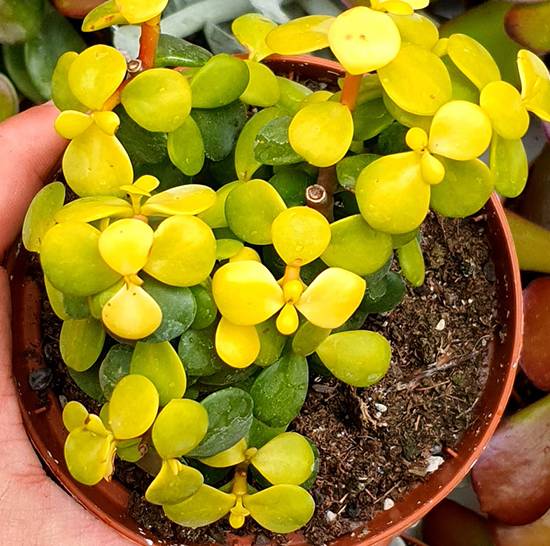
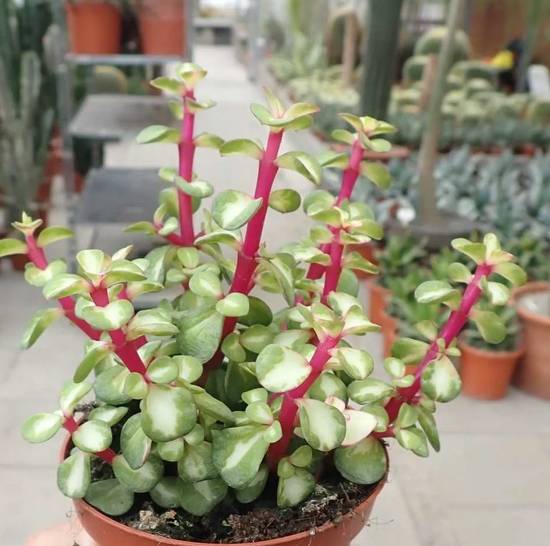
The Portulacaria Afra Lemon is a bright and highly graphic variety of the elephant bush. It stands out for its vibrant foliage in bright yellow to golden tones, sometimes tinged with light green, resembling a true ray of sunshine in a succulent collection. Compact and well-branched, this succulent is ideal for modern arrangements, hanging baskets, or tall containers, where its cascading foliage immediately catches the eye.

Easy to grow, Portulacaria Afra Lemon is an excellent choice for beginner gardeners. It tolerates pruning well, can be shaped into a bonsai, and grows quickly under good conditions. Its drought tolerance, combined with dense growth, also makes it a perfect plant for exposed balconies, rock gardens, or bright interiors.

Like its relatives, this variety has CAM metabolism, allowing it to fix carbon at night and reduce water loss. This makes it a resilient, low-maintenance plant that will find its place in any bright interior.

The Portulacaria Afra Lemon is a horticultural form derived from Portulacaria afra, a species endemic to the arid regions of South Africa.
To reveal the full intensity of its lemon-colored foliage, light exposure is essential.

🌞 Bright light to filtered sun : A well-exposed location will promote compact growth and vibrant tones.

🚫 To avoid : Shaded areas, where the plant may become leggy and lose its variegation.
Watering should be adapted to the season and exposure to maintain proper moisture balance.

💧 Spring / Summer : Water deeply about every 15 days, when the substrate is thoroughly dry.

❄️ Winter : Reduce to one watering every 4 to 6 weeks, or stop completely if the plant is resting in cool conditions.
Portulacaria Afra Lemon enjoys warmth but tolerates temperature fluctuations well.

🌡️ Ideal range : 20 °C to 28 °C during the growing season.

❄️ Hardiness : Tolerates occasional temperatures around 5 °C if the soil remains dry.
To avoid any risk of rot, a very well-draining substrate is essential.

🪨 Ideal composition : 50% cactus substrate, 25% perlite and 25% pozzolana. This mix ensures optimal aeration and limits water stagnation.
Although discreet, the flowering of Portulacaria Afra Lemon can bring an unexpected touch of softness.

🌸 Period : In spring or summer on mature specimens, rarely indoors.

🎨 Flowers : Small and pink, appearing in light clusters at the tips of the stems.
FAQ - Portulacaria Afra Lemon

How should Portulacaria Afra Lemon be cared for in a pot?
Portulacaria Afra Lemon thrives in a pot with good drainage. Provide a suitable mix of cactus substrate, perlite, and pumice to ensure healthy roots.
Can Portulacaria Afra Lemon live indoors all year round?
Yes, provided it has good natural light, such as a south- or west-facing window. It adapts very well to apartment living.
What is the minimum temperature for Portulacaria Afra Lemon?
This plant tolerates temperatures down to 5°C if kept dry. Below that, bring it indoors for winter.
How can I prevent Portulacaria Afra Lemon from losing its yellow color?
Insufficient light is often the cause. Place it in full sun or bright light to intensify its lemon-yellow tones.
When and how should Portulacaria Afra Lemon be fertilized?
Apply a monthly dose of a succulent fertilizer from spring to summer to boost growth.
Can Portulacaria Afra Lemon be pruned?
Yes, it tolerates pruning very well. Pruning helps densify the plant and shape it attractively.
How can I tell if I am overwatering or underwatering my Portulacaria Afra Lemon?
Soft, translucent leaves = too much water. Wrinkled leaves = not enough water. Always wait until the substrate dries before watering.
Is Portulacaria Afra Lemon edible?
Although it is not toxic, it is not intended for human consumption. It is primarily ornamental.
How can Portulacaria Afra Lemon be propagated?
Propagation is very easy: cut a healthy stem, let it dry for 48 hours, then replant it in dry, well-draining substrate.
Is Portulacaria Afra Lemon suitable for dry gardens?
Yes, it is an excellent plant for Mediterranean or dry gardens. It tolerates drought and full sun very well.