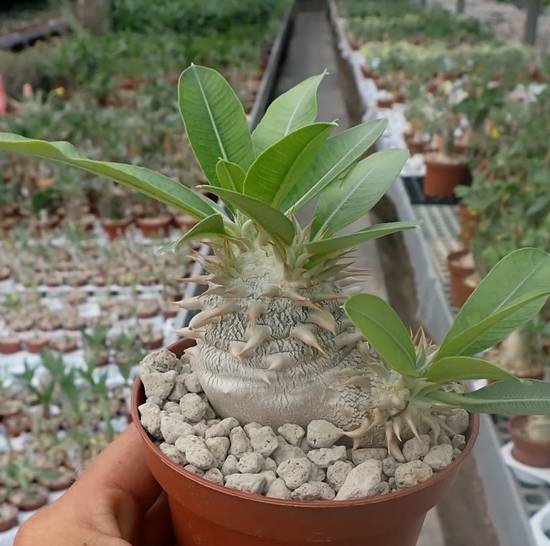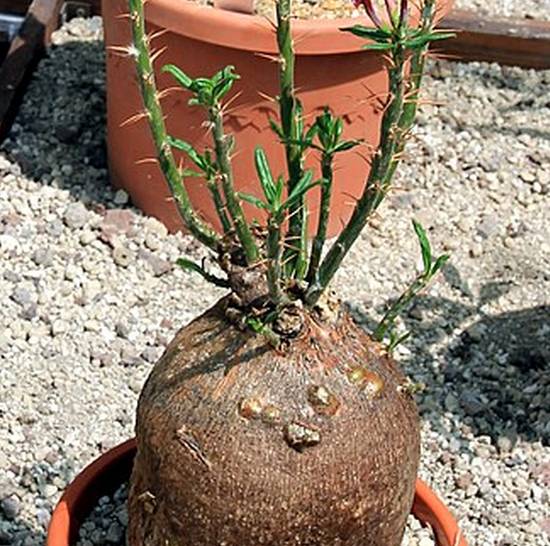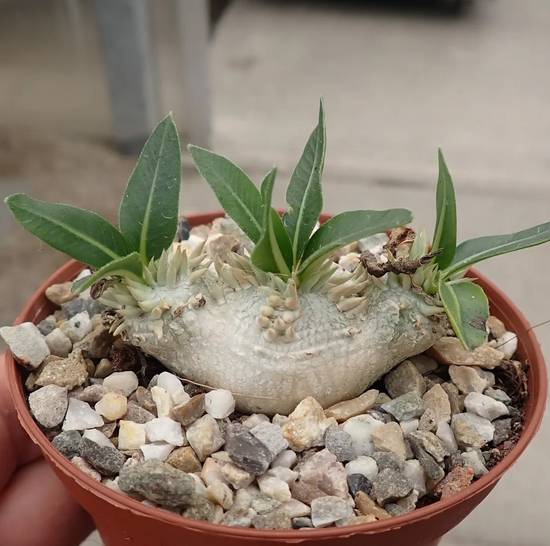
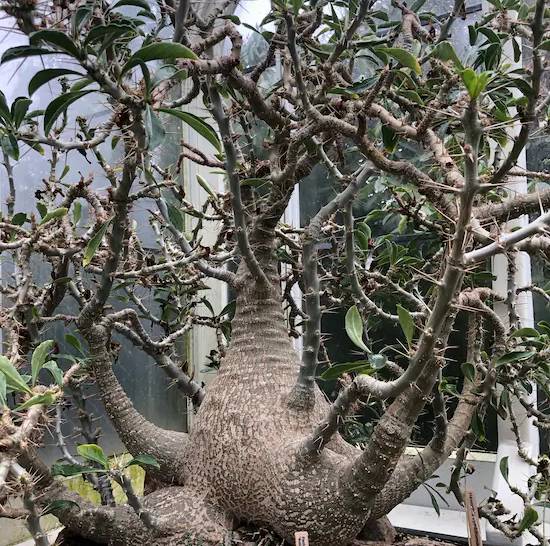
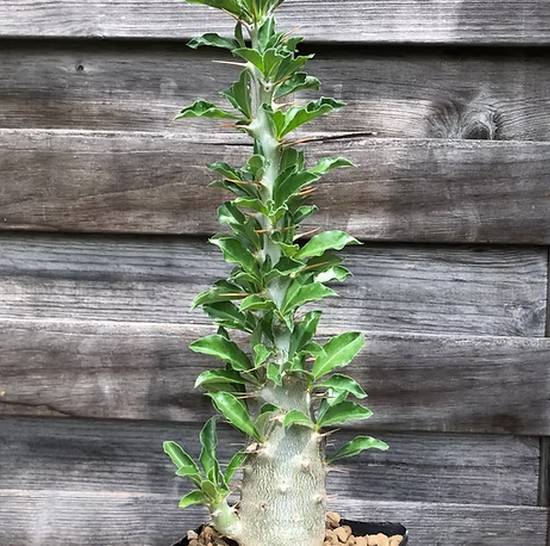
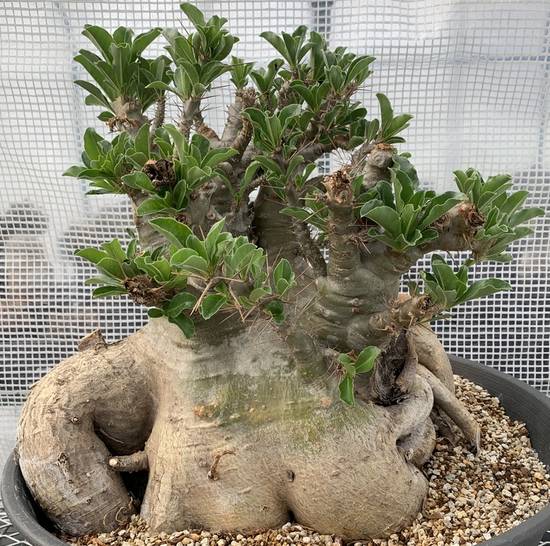
Pachypodium Saundersii

Pachypodium Saundersii

Pachypodium Saundersii

The Pachypodium Saundersii, sometimes called the "Natal bottle palm", is a succulent plant native to southern Africa, mainly South Africa, Eswatini (Swaziland) and Zimbabwe. Belonging to the Apocynaceae family, it differs from other Pachypodium species by its more shrubby habit and spectacular flowering. This small caudiciform tree, highly prized by collectors, can develop a swollen, sometimes branched trunk that stores water and allows it to withstand long periods of drought.

Pachypodium Saundersii can reach 1 to 2 meters in height when planted in the ground, but remains much more compact in pots. Its branches are thick and spiny, bearing dark green oblong leaves that are deciduous during the dry season. One of the main attractions of this species is its generous flowering: large white flowers with a pink to purple center appear in late summer or early autumn, reminiscent of frangipani (Plumeria), with which it shares botanical affinities.

The Pachypodium Saundersii grows in rocky areas, often on sandy soils or among granite outcrops, exposed to strong sunlight. It is perfectly adapted to contrasting seasons: hot and rainy summers, cool and dry winters.
The Pachypodium Saundersii loves the sun and needs it to grow properly:

🌞 Outdoors: Full sun is essential during the growing season.

🏠 Indoors: South or southwest exposure with at least 6 hours of direct light per day.

⚠️ Warning: Avoid dark locations, as the plant will quickly become etiolated.
The Pachypodium Saundersii is a xerophytic plant that stores water in its trunk:

🌱 Spring / summer: Water moderately every 10 to 15 days when the substrate is dry.

🍂 Autumn / winter: Space watering widely, or stop completely if the plant loses its leaves.

💡 Tip: Never allow water to stagnate in the saucer.
The Pachypodium Saundersii is more cold-tolerant than some other Pachypodium species:

🌡️ Optimal range: Between 20°C and 30°C.

❄️ Cold tolerance: Can withstand light frosts down to -2°C if the soil is completely dry.

🏠 Advice: Grow under shelter in winter in regions with humid climates.
The substrate must be very well-draining to prevent rot:

🪨 Recommended mix: 40% cactus potting soil + 30% perlite + 30% pumice.
The flowering of Pachypodium Saundersii is as spectacular as it is anticipated:

🌼 Color: White flowers with a pink to mauve center, trumpet-shaped.

📅 Period: Late summer to early autumn.

🧡 Specificity: Flowering is abundant on mature plants with strong light exposure.
FAQ - Pachypodium Saundersii

What is the best exposure for Pachypodium Saundersii?
It requires full sun for at least 6 hours per day to develop properly.
What type of soil should be used for Pachypodium Saundersii?
Use a well-draining substrate made of cactus soil mixed with mineral materials such as perlite and volcanic rock.
How should Pachypodium Saundersii be watered properly?
Water moderately in summer, allowing the substrate to dry completely. In winter, watering should be minimal.
Is it normal for Pachypodium Saundersii to lose its leaves?
Yes, this is normal in winter. The plant enters dormancy and resumes growth in spring.
When does Pachypodium Saundersii bloom?
It blooms in late summer, producing large white flowers with a pink center.
Should Pachypodium Saundersii be fertilized?
Yes, apply a succulent fertilizer in spring and summer every 3 to 4 weeks.
Does Pachypodium Saundersii tolerate frost?
It tolerates only very light frost (down to about -2°C) and only if the substrate is completely dry.
Can Pachypodium Saundersii be grown indoors?
Yes, as long as it receives sufficient direct light and a dry environment.
When should Pachypodium Saundersii be repotted?
Repot every 2 to 3 years in spring using a pot with drainage holes and a suitable well-draining substrate.
Is Pachypodium Saundersii toxic?
Yes, like all pachypodiums, it contains irritating sap. Avoid contact with eyes and mouth.