Euphorbia Bupleurifolia

Euphorbia Bupleurifolia

Euphorbia Bupleurifolia

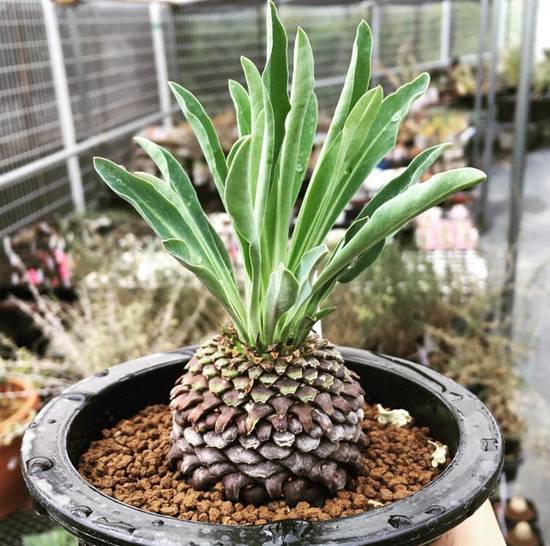
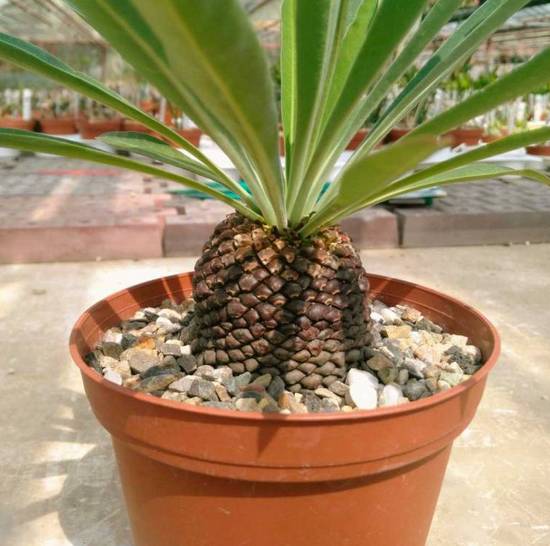
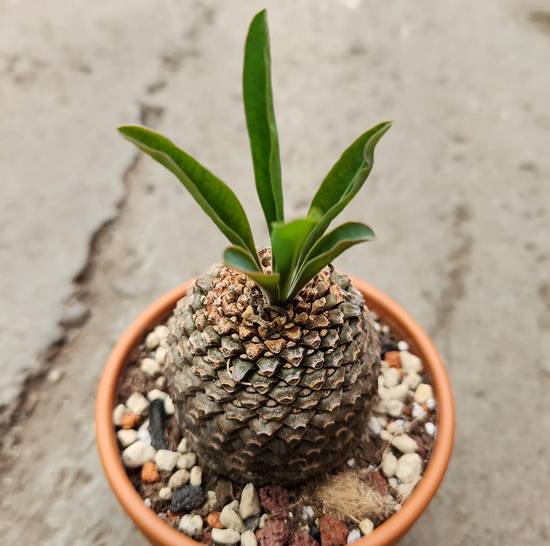
The Euphorbia Bupleurifolia is a fascinating caudiciform plant, highly sought after by collectors for its unique appearance and mini tropical tree look. It forms a globular caudex at the base, often brown or grey-green and rough like a trunk, from which leafy stems emerge, reminiscent of certain ferns or forest plants. The foliage, deciduous in winter, consists of dark green, long and slender leaves, slightly arched, giving the plant an exotic and almost prehistoric appearance. Its slow growth and rarity make it an exceptional specimen for lovers of unusual plants.

This succulent species resembles no other Euphorbia. It combines the architecture of a decorative caudex with the lightness of airy foliage. Its appearance evolves through the seasons, shifting from a bare sculptural trunk in winter to a very graphic leafy clump in summer. Grown in pots, it performs beautifully in a collection of rare succulents or on a minimalist shelf.

In its natural habitat, the Euphorbia Bupleurifolia grows in semi-arid regions of South Africa, mainly in the eastern provinces, on poor and well-draining soils. It takes advantage of rainy seasons to develop quickly, then enters dormancy during the dry season. This adaptation to a harsh climate explains its ability to survive in pots with little maintenance, provided its natural cycles are respected.
To reveal the full beauty of the Euphorbia Bupleurifolia, good brightness is essential:

🌞 Bright light: Place it in a well-lit spot, such as a south- or west-facing windowsill. It enjoys filtered sun or a few hours of gentle direct sunlight.

🌤️ Summer caution: Too intense exposure during the hottest hours may burn young leaves. Provide light shade in midsummer if grown outdoors.
Like all caudiciform plants, watering the Euphorbia Bupleurifolia must be moderate and adapted to its cycles:

💧 During the growing period (spring-summer): water moderately every 15 to 20 days, allowing the substrate to dry completely between waterings.

❄️ In winter: the plant enters dormancy, loses its leaves and should hardly be watered.

⚠️ Risk of rot: The caudex does not tolerate stagnant water. It is better to forget a watering than to overwater.
The Euphorbia Bupleurifolia is sensitive to cold and must be protected:

🌡️ Ideal temperatures: between 20 and 28 °C during the warm season.

❄️ Minimum: do not drop below 10 °C. It does not tolerate frost.

🏡 Advice: In winter, bring it indoors into a bright room, protected from humidity and cold.
🪨 A well-draining substrate is absolutely essential for this species:

Use a mixture of cactus substrate and perlite at 50% to aerate the soil around the caudex. On the surface, a layer of pumice stone improves evaporation and prevents excess moisture.
Discreet but interesting:

🌸 Period: generally in spring, sometimes as early as late winter if the plant has awakened well.

🌼 Appearance: Small greenish inflorescences, appearing at the leaf axils or directly on the caudex. It is modest flowering, but confirms the plant’s good health.
FAQ - Euphorbia Bupleurifolia

How should Euphorbia Bupleurifolia be properly watered to avoid rot?
It is essential to space out watering: during the growing period, water every 15 to 20 days only when the substrate is perfectly dry. In winter, almost completely stop watering. Excess water can cause caudex rot.
What is the ideal light exposure for Euphorbia Bupleurifolia?
Provide a bright location with several hours of gentle sun per day. A well-exposed windowsill is perfect. Avoid prolonged shade, which slows its growth.
Can Euphorbia Bupleurifolia be grown indoors all year round?
Yes, as long as you provide plenty of natural light. It adapts very well indoors, especially in cold climates, provided excess humidity is avoided.
Should Euphorbia Bupleurifolia be pruned?
No, this plant does not require pruning. You can simply remove dead or damaged leaves during the dormant season.
What substrate should be used for Euphorbia Bupleurifolia?
A very well-draining mix is recommended, such as a cactus substrate enriched with perlite and a layer of pumice on the surface.
Is Euphorbia Bupleurifolia toxic to animals?
Yes, like most euphorbias, it produces an irritating latex that can be dangerous for pets.
Why is my Euphorbia Bupleurifolia losing its leaves?
This is completely normal in winter: the plant enters dormancy. Leaf loss is not a problem if the caudex remains firm.
How can you tell if Euphorbia Bupleurifolia is dormant?
It stops producing new leaves, sheds the old ones, and halts its growth. At that time, drastically reduce watering.
Can Euphorbia Bupleurifolia be propagated by cuttings?
Propagation is difficult. It can be done by seed, but caudex cuttings are very delicate. It is mainly reproduced by seeds.
What are the most common mistakes to avoid with Euphorbia Bupleurifolia?
Overwatering, overly compact substrate, or lack of light are the main causes of failure. Respecting its natural needs is key.