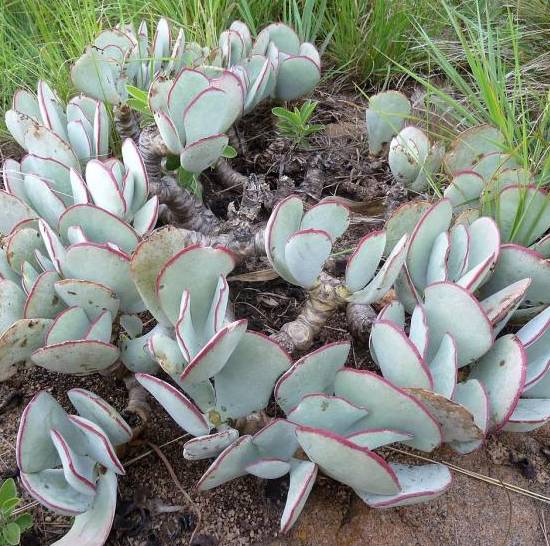
Cotyledon Orbiculata
The Cotyledon Orbiculata is a succulent native to southern Africa, as robust as it is elegant. Appreciated for the beauty of its fleshy leaves and its spectacular flowering, this plant has become a must-have in succulent collections as well as in dry rock gardens. It stands out for its compact habit, decorative foliage and ease of cultivation.
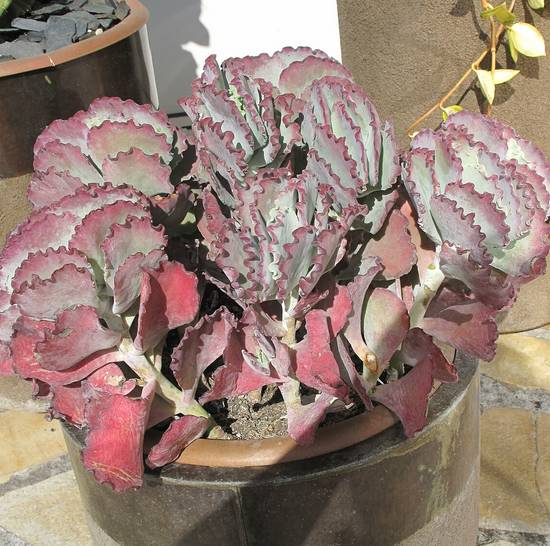
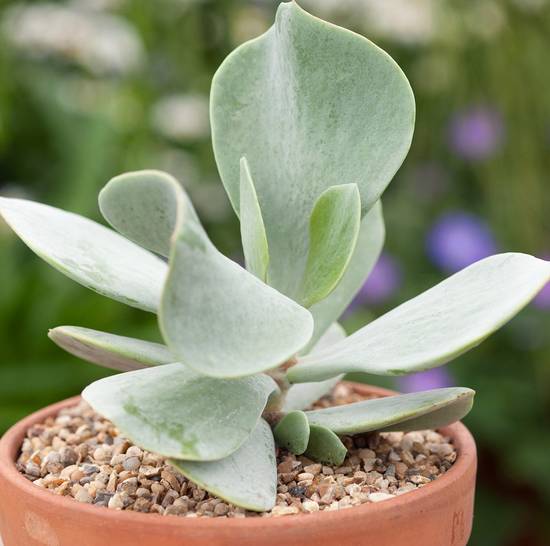
Its thick, paddle-shaped oval to rounded leaves display a grey-green to bluish tone, often edged with red when exposed to strong sunlight. This bright red marginal coloration is one of its main attractions, enhancing the contrast with the powdery, sometimes almost silvery texture of the foliage. The underside of the leaves is also covered with a light down, which helps the plant limit water loss.
The Cotyledon Orbiculata is endemic to the arid and semi-arid regions of southern Africa. It is mainly found in the Cape Province of South Africa, where it grows in rocky and steep environments. It settles between stones, on sandy or granitic soils, benefiting from the natural drainage of these areas to avoid rot. The climate of these regions is marked by strong temperature variations and rare but intense rainfall, shaping a plant perfectly adapted to drought, intense sunlight and poor soils.
The Cotyledon Orbiculata is a sun-loving plant that requires plenty of light to maintain its compact form and beautiful colors.
🌞 Ideal: Full sun exposure, at least 6 hours per day.
🌤️ Bright indoor position: Place near a south-facing window. Insufficient light will quickly cause etiolation.
Direct sunlight intensifies the red leaf margins and promotes flowering.
🌞 Ideal: Full sun exposure, at least 6 hours per day.
🌤️ Bright indoor position: Place near a south-facing window. Insufficient light will quickly cause etiolation.
Direct sunlight intensifies the red leaf margins and promotes flowering.
The Cotyledon Orbiculata is highly drought-tolerant but fears excess moisture.
🌱 Spring / Summer: Water every 10 to 15 days, allowing the substrate to dry completely between waterings.
🍂 Autumn / Winter: Water very sparingly, or not at all if temperatures are low and the plant is dormant.
⚠️ Tip: Avoid leaving standing water in saucers under pots.
🌱 Spring / Summer: Water every 10 to 15 days, allowing the substrate to dry completely between waterings.
🍂 Autumn / Winter: Water very sparingly, or not at all if temperatures are low and the plant is dormant.
⚠️ Tip: Avoid leaving standing water in saucers under pots.
The Cotyledon Orbiculata enjoys warm climates.
🌡️ Ideal temperatures: Between 20°C and 30°C.
❄️ Minimum tolerance: Can briefly tolerate 0°C in dry soil, but not prolonged frost.
🏠 In winter: Keep in a bright, frost-free place at mild temperatures (10–15°C).
🌡️ Ideal temperatures: Between 20°C and 30°C.
❄️ Minimum tolerance: Can briefly tolerate 0°C in dry soil, but not prolonged frost.
🏠 In winter: Keep in a bright, frost-free place at mild temperatures (10–15°C).
The Cotyledon Orbiculata requires a light, well-draining substrate.
🪨 Recommended mix: 50% cactus potting soil, 25% perlite, and 25% pumice.
🪨 Recommended mix: 50% cactus potting soil, 25% perlite, and 25% pumice.
One of the most striking features of the Cotyledon Orbiculata.
🗓️ Period: From June to September in warm climates, sometimes earlier indoors.
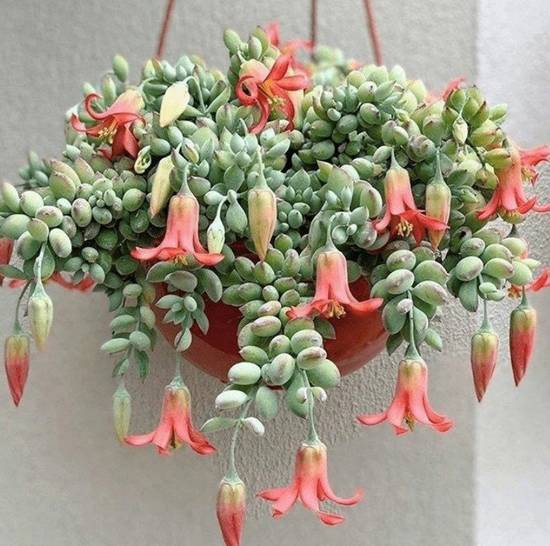
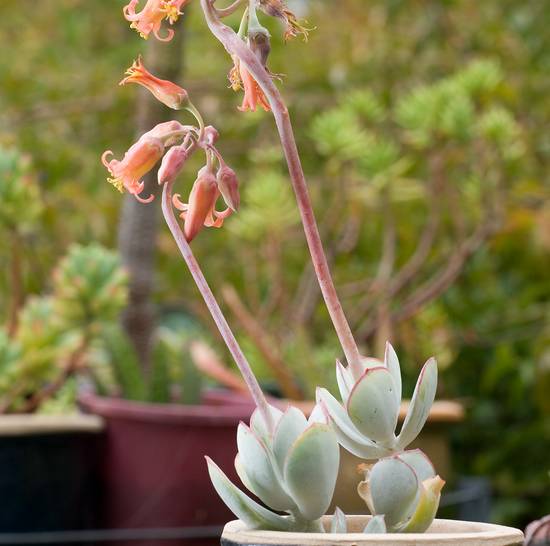
🎨 Appearance: Long flowering stems bearing pendulous red or orange flowers.
🐝 Pollinators: Attracts bees, birds and other pollinating insects.
💡 Tip: Provide a balanced fertilizer in spring to encourage flowering.
🗓️ Period: From June to September in warm climates, sometimes earlier indoors.
🎨 Appearance: Long flowering stems bearing pendulous red or orange flowers.
🐝 Pollinators: Attracts bees, birds and other pollinating insects.
💡 Tip: Provide a balanced fertilizer in spring to encourage flowering.
FAQ - Cotyledon Orbiculata
What is the ideal exposure for Cotyledon Orbiculata?
It requires very bright exposure. Outdoors, place it in full sun. Indoors, position it near a south-facing window.
How should Cotyledon Orbiculata be watered properly?
In summer, water every 10 to 15 days once the substrate is completely dry. In winter, drastically reduce or stop watering if the plant is dormant.
What substrate should be used for Cotyledon Orbiculata?
A very well-draining mix is essential. Combine a suitable substrate with perlite and volcanic rock to prevent water retention.
Is Cotyledon Orbiculata frost-resistant?
It can tolerate temperatures close to 0°C briefly if the soil is perfectly dry. However, it does not withstand prolonged frost. Bring it indoors at the first signs of freezing temperatures.
How can you recognize a lack of light in Cotyledon Orbiculata?
It becomes stretched and loses its compact shape when light is insufficient. Leaves may pale and stems elongate in search of light.
When does Cotyledon Orbiculata bloom?
It generally blooms in summer, between June and September, producing long flower stalks with decorative red or orange bell-shaped flowers.
Should Cotyledon Orbiculata be pruned?
Pruning is not necessary, but you may remove faded flowers or damaged stems to maintain an attractive shape.
What fertilizer should be used for Cotyledon Orbiculata?
During the growing season, apply a succulent fertilizer once a month to promote abundant flowering and vigorous foliage.
Is Cotyledon Orbiculata toxic?
Yes, it can be toxic if ingested by pets. Prevent animals from chewing its leaves.
Can Cotyledon Orbiculata live in a pot its entire life?
Yes, it grows perfectly well in a pot for its entire life, provided it has well-draining substrate and a container with drainage holes.