
Sulcorebutia Rauschii

Sulcorebutia Rauschii

Sulcorebutia Rauschii

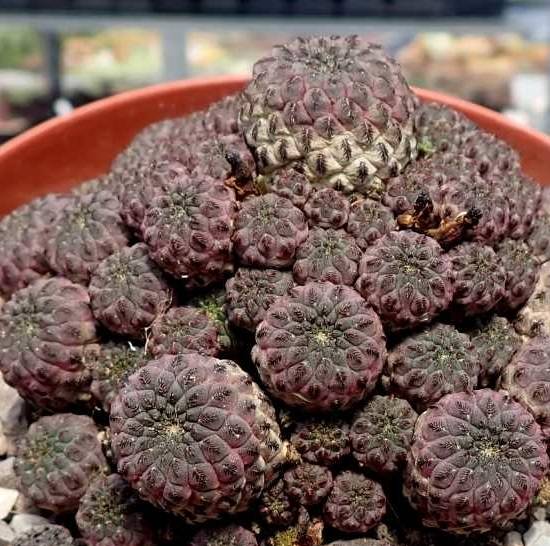
The Sulcorebutia Rauschii is a miniature cactus species native to Bolivia, renowned for its unusual appearance and exceptional coloration. It immediately appeals to exotic plant enthusiasts thanks to its colors ranging from deep purple to bronze green, its geometric forms, and its surprisingly generous flowering for such a small cactus.

The plant forms a clump of globular or slightly flattened heads, measuring 2 to 4 cm in diameter. Each head is covered with numerous ribs arranged in regular spirals, whose areoles bear tiny cream-white to yellowish spines, often barely prickly. This spiral pattern gives it an almost fractal, hypnotic, and highly decorative appearance.

It is common to see specimens take on a violet or purplish coloration at maturity, especially when exposed to direct light. This pigmentation is enhanced by moderate light or water stress, making it even more interesting in collections. Despite its small size, the Sulcorebutia Rauschii is a true star of display pots.

The Sulcorebutia Rauschii originates from the high mountains of Bolivia, more specifically from the Cochabamba region, at altitudes ranging between 2,500 and 3,500 meters. It grows in rocky environments, on slopes well exposed to the sun, where nighttime temperatures can be low despite strong daytime sunlight.

These extreme conditions have allowed it to develop great resistance to temperature fluctuations, making it a perfect plant for experienced collectors.
Good lighting is essential to maintain its compact shape and vibrant colors.

🌞 Bright light: Full sun or slightly filtered exposure. The more light it receives, the more intense its colors become.

🌤️ Tip: In summer, prefer morning sun and afternoon shade to avoid burns.

⚠️ Watch out: Indoors, place it behind a well-exposed window or use a grow light.
Although it comes from the Andean highlands, the Sulcorebutia Rauschii requires a watering cycle adapted to pot cultivation.

🌱 Spring / summer: Water about every 15 days, allowing the substrate to dry completely. It appreciates moderate water stress.

🍂 Autumn / winter: Stop watering. This resting period is essential for future flowering.

💡 Tip: Avoid any water stagnation. Excess moisture can cause collar rot.
This mountain cactus is accustomed to extreme conditions.

🌡️ Growth temperature: 15 to 25 °C.

❄️ Cold tolerance: Down to 0 °C or even -2 °C briefly if the substrate is dry.

🏠 Wintering advice: Keep it cool (5 to 10 °C) in winter to induce flowering the following spring.
Good drainage is essential to prevent excess moisture, especially in winter.

🪨 Ideal substrate: 60% mineral components (pumice, gravel, perlite) + 40% cactus potting mix.
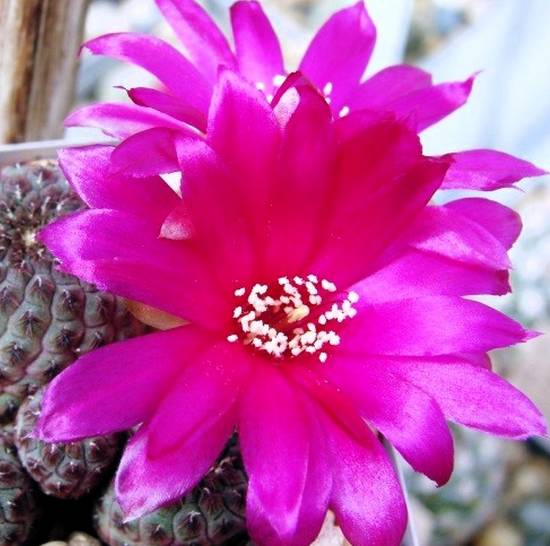
Despite its small size, the Sulcorebutia Rauschii produces beautiful, colorful flowers.

🌸 Season: Spring, sometimes extending into early summer.

🎨 Flowers: Yellow, orange, sometimes magenta, funnel-shaped, up to 3 cm in diameter.

💡 Encouraging flowering: Respect winter dormancy and provide good light exposure.
FAQ - Sulcorebutia Rauschii

Why does Sulcorebutia Rauschii change color?
This cactus turns purple or bronze when exposed to bright light or subjected to controlled water stress.
How often should Sulcorebutia Rauschii be watered?
During the growing season, water every 15 days once the substrate is completely dry. In winter, stop watering.
Can Sulcorebutia Rauschii live outdoors in winter?
It can tolerate light frosts (down to -2°C) if kept dry. However, it is best to bring it indoors as soon as temperatures drop below 5°C.
What type of pot is suitable for Sulcorebutia Rauschii?
A terracotta pot promotes good evaporation. Do not forget to add a layer of drainage at the bottom.
Can Sulcorebutia Rauschii be fertilized?
Yes, use a liquid cactus fertilizer once a month between April and July.
How can I stimulate the flowering of Sulcorebutia Rauschii?
Provide a cool winter, plenty of light in spring, and a suitable nutrient supply.
Is Sulcorebutia Rauschii suitable for beginners?
Yes, it is easy to grow if watering and exposure rules are respected. Its small size makes it ideal for limited spaces.
Should it be repotted often?
Repotting every 2 to 3 years is sufficient, using a well-draining substrate.
Why is my Sulcorebutia Rauschii not flowering?
It needs a cool winter rest period and maximum light exposure in spring.
Can Sulcorebutia Rauschii be grown in a terrarium?
No, the confined humidity of a terrarium is unsuitable. It prefers a dry and well-ventilated environment.