Copiapoa Haseltoniana
The Copiapoa Haseltoniana is one of the most intriguing cacti of the Atacama Desert, renowned for its exceptional appearance and remarkable adaptation to extreme conditions.
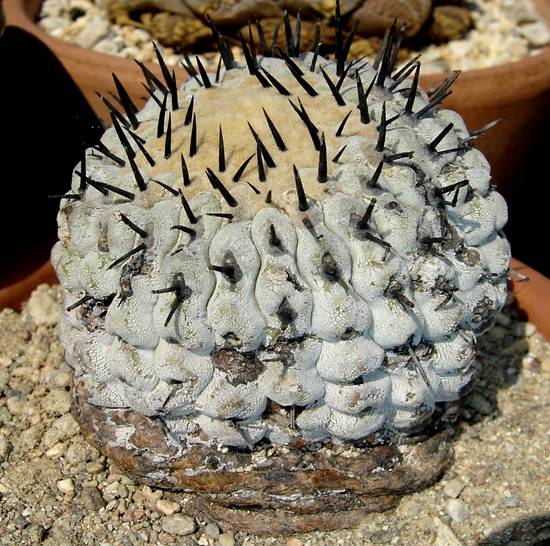
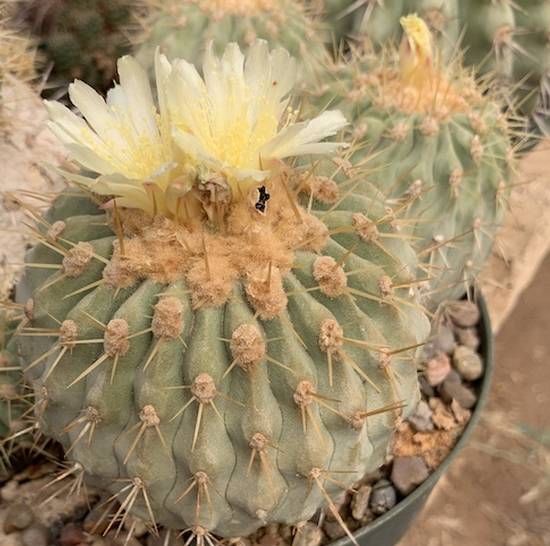
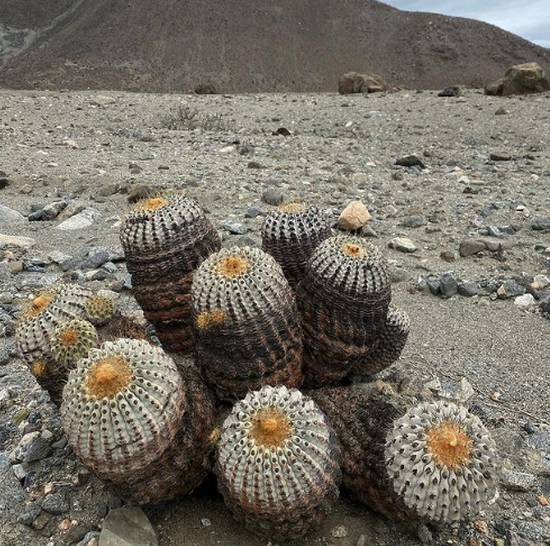
This cactus has a globular to cylindrical body covered with a distinctive powdery white bloom, giving it a striking silvery appearance. This protective coating reflects sunlight and helps the plant survive in an extremely arid environment. With age, Copiapoa haseltoniana can reach around 30 cm in diameter and form impressive clumps.
The spirally arranged areoles bear robust spines, usually black to dark grey, creating a strong contrast with its pale epidermis and enhancing its sculptural, graphic look. Each specimen is unique, making it a true collector’s gem.
The Copiapoa Haseltoniana is native to the desert regions of northern Chile, mainly in the Atacama area, known as one of the driest places on Earth.
In the wild, it grows on rocky hills exposed to intense sunlight year-round, with extremely low rainfall, which explains its exceptional resistance to harsh conditions.
In the wild, it grows on rocky hills exposed to intense sunlight year-round, with extremely low rainfall, which explains its exceptional resistance to harsh conditions.
For optimal development of the Copiapoa Haseltoniana, sun exposure is essential:
🌞 Full sun: At least 6 to 8 hours per day.
🌤️ Light summer protection: During prolonged heatwaves, slight shading can prevent superficial sunburn.
A lack of light would significantly reduce its unique appearance.
🌞 Full sun: At least 6 to 8 hours per day.
🌤️ Light summer protection: During prolonged heatwaves, slight shading can prevent superficial sunburn.
A lack of light would significantly reduce its unique appearance.
The Copiapoa Haseltoniana requires very controlled watering, typical of desert cacti:
🌱 Spring / summer: Moderate watering every 2 to 4 weeks, allowing the substrate to dry completely between waterings.
🍂 Autumn / winter: Stop or drastically reduce watering to prevent root rot.
⚡ Important: Excess water is fatal. Always underwater rather than risk stagnant moisture.
🌱 Spring / summer: Moderate watering every 2 to 4 weeks, allowing the substrate to dry completely between waterings.
🍂 Autumn / winter: Stop or drastically reduce watering to prevent root rot.
⚡ Important: Excess water is fatal. Always underwater rather than risk stagnant moisture.
The Copiapoa Haseltoniana prefers warm to moderate temperatures:
🌡️ Optimal growth range: Between 20°C and 35°C.
❄️ Minimum tolerance: Can occasionally withstand temperatures close to 5°C but does not tolerate frost.
🏠 Wintering: Keep indoors in a bright, cool place once temperatures drop below 10°C.
🌡️ Optimal growth range: Between 20°C and 35°C.
❄️ Minimum tolerance: Can occasionally withstand temperatures close to 5°C but does not tolerate frost.
🏠 Wintering: Keep indoors in a bright, cool place once temperatures drop below 10°C.
A mineral substrate is essential for its health:
🪨 Recommended mix: 50% cactus soil + 30% gravel or pumice + 20% perlite.
🪨 Recommended mix: 50% cactus soil + 30% gravel or pumice + 20% perlite.
The flowering of the Copiapoa Haseltoniana, although discreet, is very rewarding for growers:
🌸 Season: Spring or summer, depending on conditions.
🎨 Color: Pale yellow to bright yellow, sometimes slightly orange.
🕑 Duration: Short-lived, about 2 to 4 days per flower.
This flowering usually appears on mature plants with excellent sun exposure and slight water stress.
🌸 Season: Spring or summer, depending on conditions.
🎨 Color: Pale yellow to bright yellow, sometimes slightly orange.
🕑 Duration: Short-lived, about 2 to 4 days per flower.
This flowering usually appears on mature plants with excellent sun exposure and slight water stress.
FAQ - Copiapoa Haseltoniana
What is the best exposure for Copiapoa Haseltoniana?
Place it in full sun, ideally facing south. It needs 6 to 8 hours of direct light per day to maintain its compact shape and grey color. In case of intense heat, provide light afternoon shade.
How should I water Copiapoa Haseltoniana without causing rot?
Always wait until the substrate is completely dry before watering. In summer, watering every 3 to 4 weeks is sufficient. In winter, stop watering. Use a well-draining substrate.
What type of soil is suitable for Copiapoa Haseltoniana?
A very mineral mix: cactus potting soil, perlite, pumice. Consider adding a layer of pumice on the surface to keep the collar dry.
Can Copiapoa Haseltoniana be grown indoors?
Yes, if the light is sufficient. Place it behind a south-facing window or use a grow light in winter.
Why is my Copiapoa Haseltoniana not blooming?
You need a mature cactus, a proper cool and dry winter rest, as well as a suitable fertilizer in spring.
Can Copiapoa Haseltoniana be fertilized?
Yes, with a low-nitrogen fertilizer specially formulated for cacti. Apply during the growing season, every 6 to 8 weeks, on moist substrate.
What is the minimum temperature tolerated by Copiapoa Haseltoniana?
Down to 2°C if kept dry. Cold moisture must be strictly avoided, as it causes rot.
How can I prevent my Copiapoa Haseltoniana from rotting?
Water sparingly, provide a well-draining substrate, and ensure good ventilation. Avoid cachepots without drainage holes.
How often should Copiapoa Haseltoniana be repotted?
Every 3 to 5 years. Repot in spring into a slightly larger pot with optimal drainage.
Is Copiapoa Haseltoniana suitable for beginners?
Yes, if they master spaced watering. It is hardy but slow-growing. An ideal plant to learn cactus patience.