Cintia Knuti
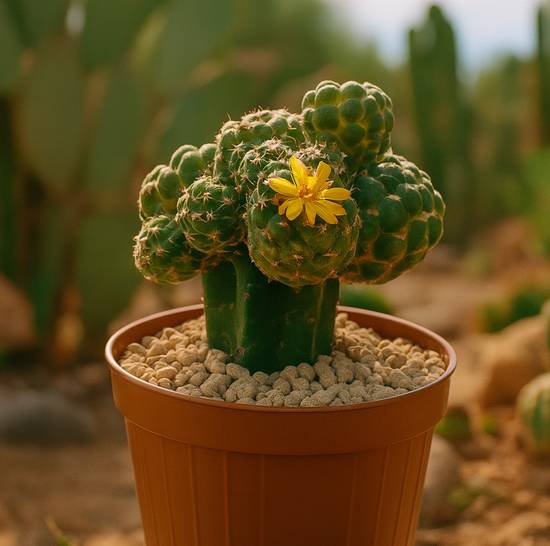
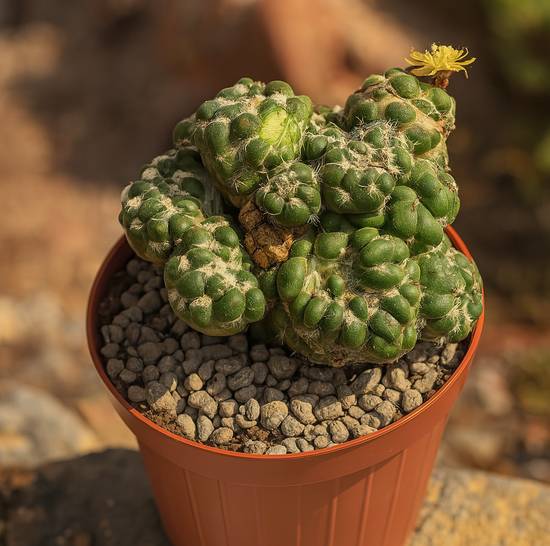
The Cintia Knutii is a dwarf and discreet yet fascinating cactus native to the high mountains of Bolivia. It is one of the jewels of the Cactaceae family, highly prized by collectors for its miniature appearance, flattened globular shape and surprising flowering.
This small cactus, rarely more than a few centimeters wide, has a matte green, slightly velvety surface, with no classic ribs or areoles. It grows slowly and remains compact, making it an ideal choice for lovers of rare plants, even in small spaces.
Despite its modest size, the Cintia Knutii stands out in spring when it produces superb bright yellow flowers, contrasting beautifully with its understated form and discreet habit.
The Cintia Knutii is endemic to the high Bolivian Andes, where it grows above 4,000 m in extreme conditions: cold nights, intense daytime light, and poor, well-drained soils.
This origin explains its excellent tolerance of dry cold and its slow but steady growth when cultivated under proper conditions.
This origin explains its excellent tolerance of dry cold and its slow but steady growth when cultivated under proper conditions.
This cactus enjoys bright light but does not tolerate intense direct afternoon sun in summer.
☀️ Outdoors: Gentle sun or light partial shade, ideally in the morning or late afternoon.
🏠 Indoors: Place near a well-lit window. Avoid overly dark locations.
☀️ Outdoors: Gentle sun or light partial shade, ideally in the morning or late afternoon.
🏠 Indoors: Place near a well-lit window. Avoid overly dark locations.
The golden rule for this mountain cactus: little water and never on a damp substrate.
🌱 Spring / summer: Water moderately every 20 to 30 days, only when the soil is completely dry.
❄️ Winter: Stop watering entirely during its vegetative rest period.
⚠️ Too much water, even in summer, will quickly cause basal rot.
🌱 Spring / summer: Water moderately every 20 to 30 days, only when the soil is completely dry.
❄️ Winter: Stop watering entirely during its vegetative rest period.
⚠️ Too much water, even in summer, will quickly cause basal rot.
It tolerates cold far better than humidity.
🌡️ Optimal temperatures: Between 15 and 25 °C.
❄️ Wintering: Down to −5 °C if the soil is completely dry. A ventilated but moisture-free shelter is preferable.
🌡️ Optimal temperatures: Between 15 and 25 °C.
❄️ Wintering: Down to −5 °C if the soil is completely dry. A ventilated but moisture-free shelter is preferable.
Like all high-altitude cacti, it requires a mineral and perfectly draining soil.
🪨 Recommended mix: 40 % cactus potting soil, 30 % perlite or drainage granules, 30 % pumice.
🪨 Recommended mix: 40 % cactus potting soil, 30 % perlite or drainage granules, 30 % pumice.
Despite its small size, the Cintia Knutii offers generous flowering when conditions are right.
📅 Season: Late spring to early summer.
🌼 Flowers: Yellow, cup-shaped, often larger than the cactus itself.
💡 Tip: Mild stress (restricted watering) in spring encourages flowering.
📅 Season: Late spring to early summer.
🌼 Flowers: Yellow, cup-shaped, often larger than the cactus itself.
💡 Tip: Mild stress (restricted watering) in spring encourages flowering.
FAQ - Cintia Knuti
How should Cintia Knutii be watered to prevent rot?
It requires very little water. Always wait until the substrate is completely dry before watering. In winter, stop watering entirely to prevent rot.
Can Cintia Knutii grow in shade?
It prefers bright light but should be protected from intense sun. Light shade or bright indirect light in summer is ideal.
What is the best substrate for Cintia Knutii?
Use a very well-draining mix: cactus soil, pumice, and perlite.
Why is my Cintia Knutii not flowering?
To encourage flowering, provide a dry winter rest, bright light, and apply a cactus fertilizer in spring.
What is the minimum temperature tolerated by Cintia Knutii?
It can tolerate temperatures down to -5°C if the substrate is completely dry. It fears cold humidity more than dry cold.
Is Cintia Knutii suitable for beginners?
Yes, it is perfect for mini-cactus enthusiasts. Simply respect its needs for light and excellent drainage to see it thrive.
How can you tell if Cintia Knutii has too much or too little water?
If it becomes soft or mushy, it likely has too much water. If it shrinks significantly or becomes very firm, it may lack water. Adjust watering carefully.
Can Cintia Knutii be grown in a pot on a balcony?
Yes, provided it has a well-draining substrate, a pot with drainage holes, and protection from excessive rain.
What is the lifespan of Cintia Knutii?
It can live for several decades if properly cared for. Its growth is slow, but its longevity is remarkable.
Where should Cintia Knutii be placed in an apartment?
Place it near a very bright south- or southwest-facing window. Avoid dark or overly humid rooms.