Eulychnia Castanea Cristata

Eulychnia Castanea Cristata

Eulychnia Castanea Cristata

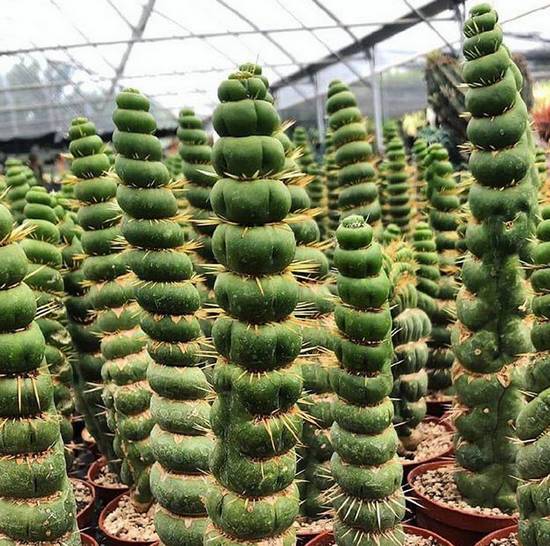
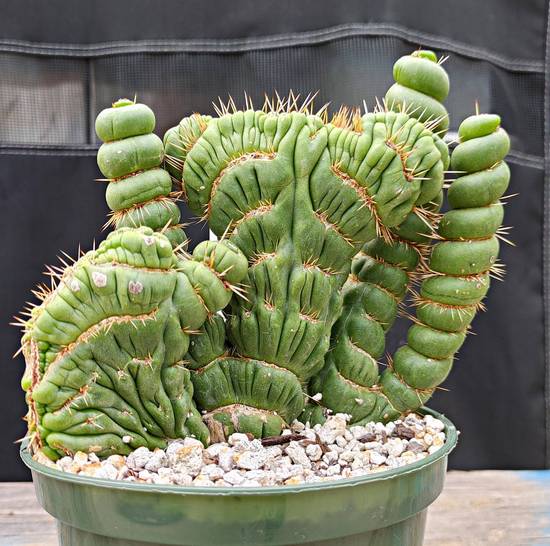
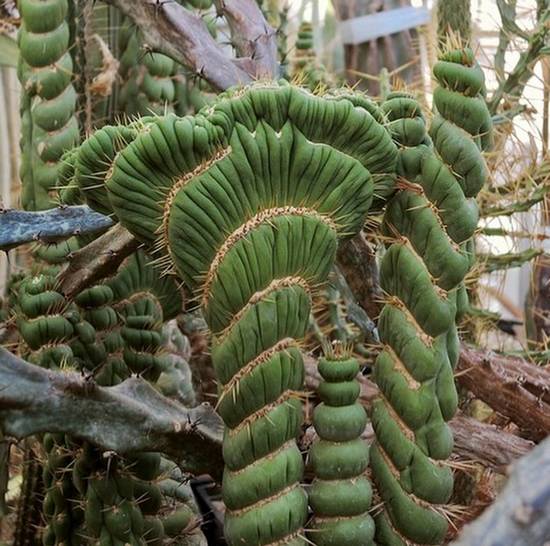
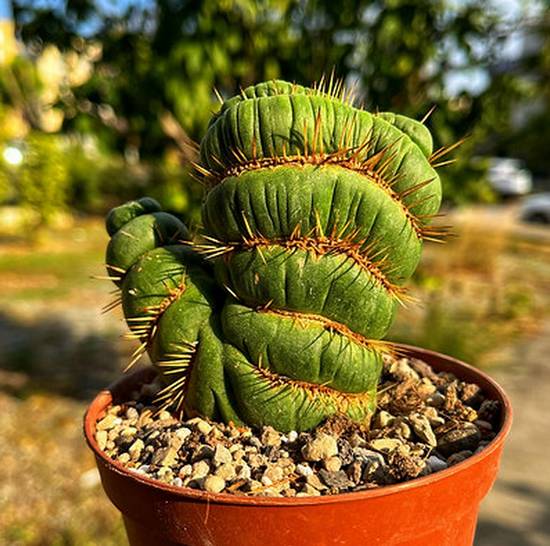
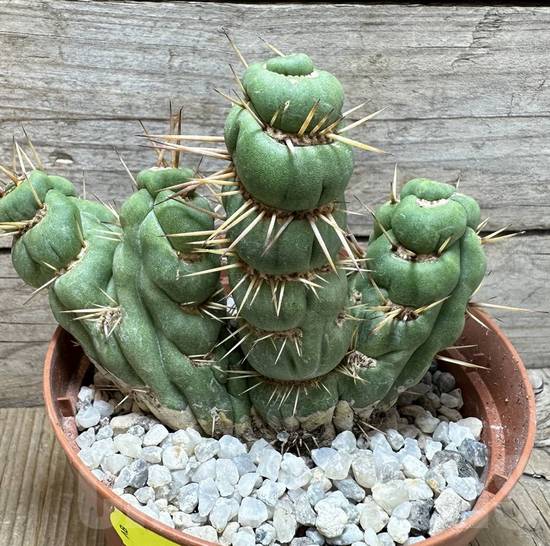
The Eulychnia Castanea Cristata is a true botanical curiosity, a rare and fascinating form of the Eulychnia genus, renowned for its impressive columnar cacti originating from South America. Here, the “crested” mutation transforms the classic vertical silhouette into a swirling ribbon of wavy crests, giving the cactus the appearance of a tormented organic sculpture.

Its growth, instead of occurring in a linear and cylindrical manner, follows an irregular, almost labyrinth-like crest. The result? A hypnotic plant, sometimes chaotic, but always spectacular, halfway between a natural work of art and a fossil relic.

Its epidermis, often dark green, is marked by a rough texture and dotted with numerous areoles. These may bear fine golden spines, although some crested forms are almost spineless. In pots, it evolves slowly but quickly gains presence, occupying space with its complex movements, like a miniature monument.

The Eulychnia genus is native to northern Chile, notably the regions of Atacama and Coquimbo. These desert areas, extremely arid, are known to receive less than 10 mm of rain per year. Plants there have developed exceptional survival strategies, including slow growth, thick skin, and tolerance to extreme temperatures.

The Castanea Cristata form does not exist in large quantities in the wild. It is a rare mutation, generally selected and propagated in cultivation by cuttings to preserve its crested form.
To fully express its beauty and maintain compact growth, the Eulychnia Castanea Cristata needs a lot of light:

🌞 Ideal exposure: full sun (at least 6 hours per day)

🌤️ Summer protection: in very hot regions, light shading can prevent burns on young tissues

A lack of light causes disordered growth, opening of the crests, and loss of firmness. It is therefore not recommended to grow it indoors without suitable artificial lighting.
Like any cactus originating from a desert climate, it is very sensitive to stagnant humidity. Its poorly developed root system is adapted to quickly capture water and to withstand long periods of drought.

🌱 Spring / summer: moderate watering every 3 to 4 weeks, only if the substrate is completely dry

🍂 Autumn / winter: no watering necessary during vegetative rest

⚠️ Tip: It is always better to underwater than to overwater. Excess water can lead to irreversible rot at the base of the crests.
The Eulychnia Castanea Cristata is a robust plant, accustomed to significant temperature variations:

🌡️ Optimal temperature: between 20°C and 35°C

❄️ Lower limit: can tolerate 5°C when dry occasionally, but must not be exposed to frost

🏠 Wintering advice: bring into a cold greenhouse or behind a bright bay window as soon as temperatures drop below 10°C
This cactus needs an extremely well-draining substrate. Roots do not like heavy or rich soils.

🪨 Recommended substrate: 60% pumice + 30% pozzolana + 10% cactus potting soil

A wide and shallow pot is recommended to stabilize the plant without retaining excess moisture.
The flowering of the Eulychnia Castanea Cristata is extremely rare in cultivation, but remains possible:

🌸 Season: late spring or early summer

🎨 Color: white to very pale pink

🕑 Duration: 1 to 3 days

💡 Conditions: prolonged sun exposure, a well-marked winter rest, and a mature plant are required
FAQ - Eulychnia Castanea Cristata

How to recognize excess moisture in an Eulychnia Castanea Cristata?
Excess moisture can cause blackening at the base of the plant, collapse of the crests or the appearance of soft spots. If the substrate remains wet too long, signs of root rot may appear.
How to know if my Eulychnia Castanea Cristata lacks water?
When the cactus lacks water, its tissues contract, the plant seems less rigid and its crests become drier to the touch. Light, spaced and controlled watering is enough to restart its growth safely.
Can Eulychnia Castanea Cristata be grown indoors?
Yes, provided it is given a very bright location, ideally near a south-facing bay window. Without sufficient light, its growth becomes irregular and its crested form may elongate or deform.
Should Eulychnia Castanea Cristata be fertilized?
Yes, but moderately. A special cactus fertilizer low in nitrogen can be applied once a month during the growing period, between May and August.
What is the growth rate of Eulychnia Castanea Cristata?
It is a slow-growing cactus. In a pot, it gains only a few centimeters per year. Its crested structure slows its development even further, but enhances its graphic character.
Can Eulychnia Castanea Cristata be repotted regularly?
No, repotting should be spaced every 3 to 4 years, only when the plant is cramped or the substrate has degraded. Too frequent repotting can unnecessarily stress the plant.
How to promote harmonious crest growth?
Sun exposure is essential. A very well-draining substrate, measured watering and a suitable pot help maintain good density and regular crest movement over the years.
Is it a good cactus for beginners?
This cactus is more recommended for enthusiasts who already have experience with crested forms. It requires good watering control, excellent light and a perfectly draining substrate.
How to propagate Eulychnia Castanea Cristata?
A secondary crest must be taken using a sterile tool, left to heal for several days, then replanted in dry substrate. Rooting may take several weeks.
Does Eulychnia Castanea Cristata flower often?
Flowering is exceptional in cultivation, especially in pots. It only occurs on very mature specimens, well exposed, that have benefited from a marked dry winter rest.