
Dorstenia Lavrani
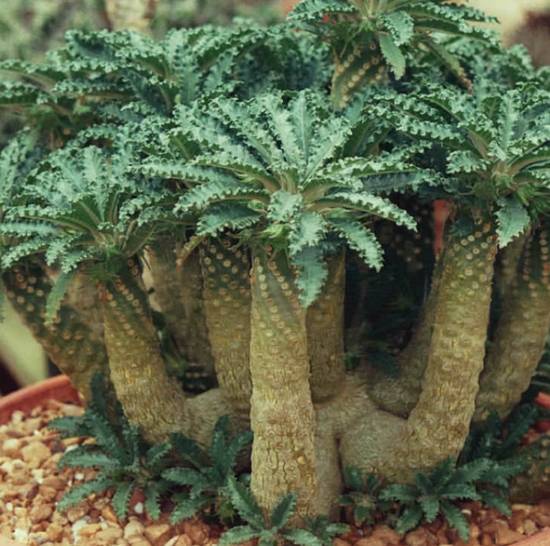
The Dorstenia Lavrani is an extremely original and still little-known succulent plant, although it is highly sought after by lovers of caudex plants and unusual forms. This botanical gem belongs to the Moraceae family — the fig family — which is surprising given its appearance that bears no resemblance to its leafy relatives. Native to the semi-arid, rocky regions of Somalia, Dorstenia Lavrani is perfectly adapted to hot and dry climates and develops over the years an almost sculptural appearance, somewhere between the exotic charm of a miniature bonsai and the strangeness of a science-fiction plant.
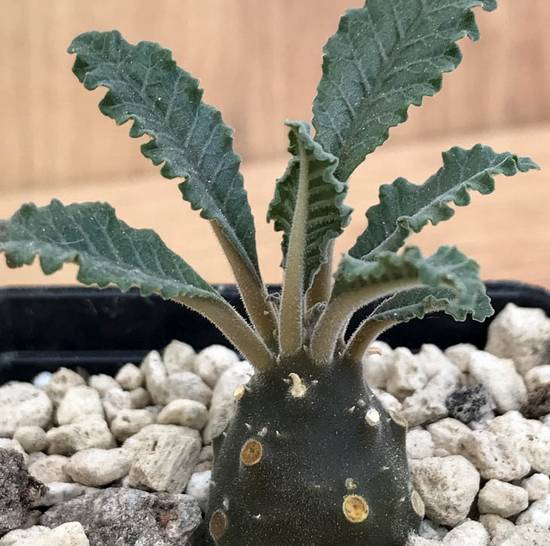
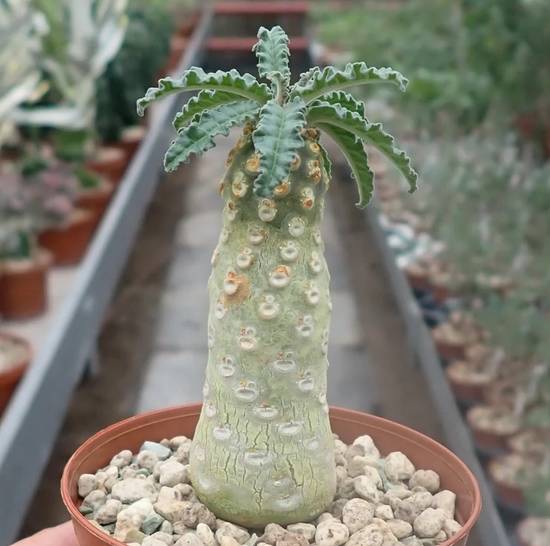
What characterizes this species is its swollen caudex, sometimes globular and sometimes more elongated, which serves as a water reserve and allows it to survive long periods of drought. From this caudex emerge branched stems bearing small, bright green leaves with pronounced veins and a slightly textured surface. But it is above all its flowering, as unexpected as it is strange, that makes it famous: the flowers are actually irregular discoid structures, flattened like green saucers, sometimes dotted with small spikes or appendages. These "flowers" are in fact inflorescences called hypanthodia, typical of the genus Dorstenia.
🌤️ Bright but indirect light: Place it near an east- or west-facing window, or in a bright veranda. It tolerates gentle morning or evening sun, but fears direct and scorching midday rays.
🌿 Bright indoor location: It is an ideal plant for well-lit apartments. Insufficient light will slow growth and reduce flowering.
⚠️ Avoid direct heat stress: In summer, excessive direct sunlight can cause burns on the delicate foliage.
💧 Spring / summer: Water moderately when the substrate is dry on the surface. On average, watering every 15 days is sufficient, but adjust according to ambient humidity and temperature.
🍂 Autumn / winter: Significantly reduce watering. It often enters semi-dormancy: water once a month, or not at all if kept in a cool location.
⚠️ Beware of excess water: A soft caudex, yellowing leaves or blackening stems are signs of rot. When in doubt, wait longer before watering.
🌞 Ideal growing temperature: Between 20°C and 30°C.
❄️ Lower limit: Never expose the plant to temperatures below 10°C. It is very sensitive to cold and does not tolerate frost.
🏠 Indoor cultivation year-round: In temperate regions, grow it indoors in a heated room near a well-lit window.
🪨 Ideal substrate: Mix cactus potting soil in equal parts with perlite or pumice.
🕳️ Drainage holes required: Prefer terracotta pots to promote evaporation.
🎨 Shape and color: The flowers resemble flat, irregular discs, green to purplish, sometimes with small protrusions. Their appearance is more decorative than fragrant.
🌿 Uniqueness: These inflorescences often appear in the leaf axils, without visible petals, reinforcing the strange and fascinating character of this plant.
💡 A well-grown plant, in a draining substrate, with bright light and warm temperatures, will flower regularly even in a pot.