
Cryptanthus Pink Star
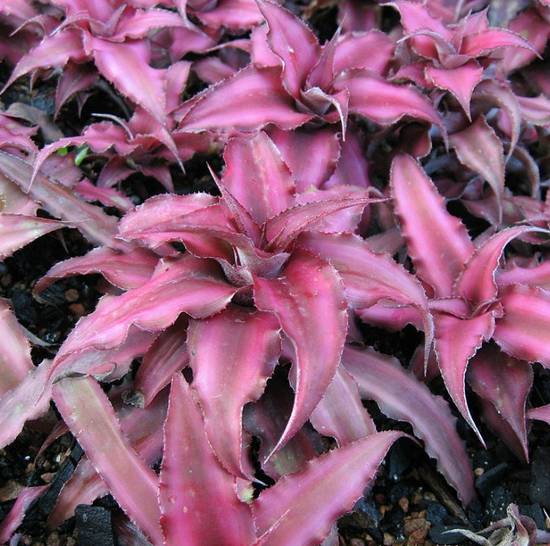
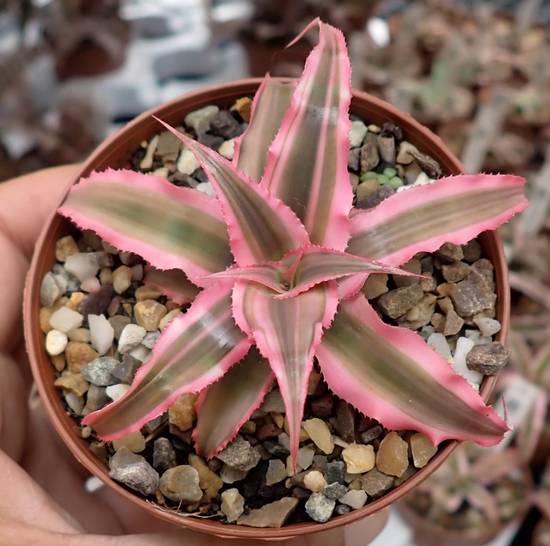
The Cryptanthus Pink Star is a fascinating terrestrial plant belonging to the Bromeliaceae family, more precisely to the Cryptanthus genus, also known as the “star-shaped terrestrial bromeliad”. Native to Brazil, this cultivar is highly prized for its exceptional foliage, displaying vibrant shades ranging from bright pink to fuchsia, sometimes marbled with silvery grey or edged with green. Its flat, highly graphic rosette gives the impression of a star resting on the substrate, hence its nickname “Starfish Plant”.
Unlike most bromeliads that grow as epiphytes, the Cryptanthus Pink Star grows directly in the soil, making it particularly suitable for pot culture or terrariums. It usually does not exceed 10 to 15 cm in height, but can spread up to 25 cm wide, making it ideal for small spaces, windowsills or indoor plant compositions. Its growth is slow but steady, and its foliage remains decorative year-round.
🌤️ Indirect light: Place it near an east- or west-facing window, behind a light curtain. Too much direct sunlight can cause leaf fading or burns.
🌱 Artificial lighting: It performs very well under LED grow lights, making it an excellent choice for decorative terrariums.
💦 Slightly moist substrate: Water as soon as the surface begins to dry. Avoid letting the pot sit in water, as this can cause root rot.
🌬️ Ambient humidity: A level between 50% and 70% is ideal. Light misting during summer may help if the air is too dry.
⚠️ Warning: Never pour water into the rosette, unlike other bromeliads. This can lead to mold or rot.
🌡️ Ideal temperature: Between 18 and 28 °C.
❄️ Minimum: Never expose it to temperatures below 10 °C. Cold slows growth and can cause permanent damage.
🏠 Indoor cultivation: Perfectly suited to indoor environments year-round, away from drafts and radiators.
🪨 Recommended substrate: A bromeliad or tropical plant mix works well, or a cactus potting soil lightened with perlite.
🌼 Appearance: Small white or greenish flower, sometimes pale pink, with limited ornamental value.
📅 Period: Usually at maturity, after several years of cultivation. The plant then dies, but produces offsets (pups).
💡 Tip: Separate and repot the offsets to maintain the plant over time.