
Browningia Hertlingiana
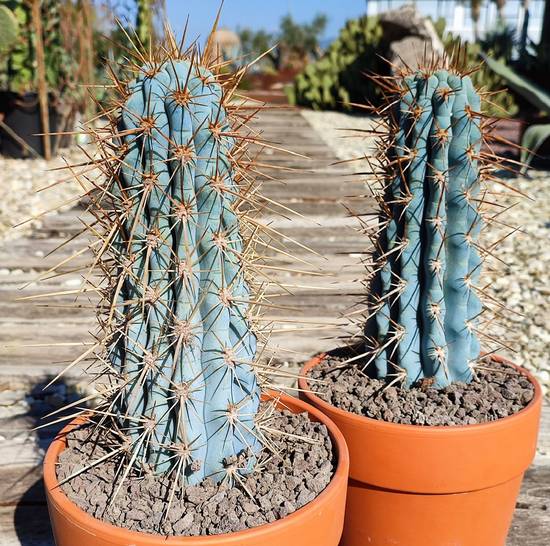
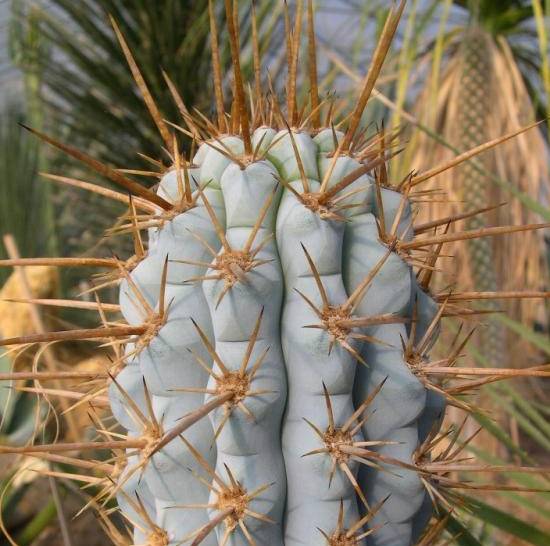
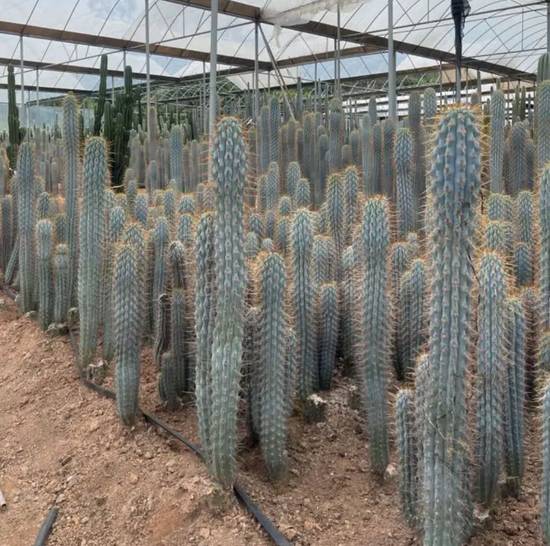
The Browningia Hertlingiana is a rare and striking columnar cactus native to the high plateaus of Peru. It immediately stands out for its spectacular steel-blue coloration, contrasted by creamy to brown spiny areoles. When young, its growth is slow and compact; as it matures, it can reach several meters in height, becoming a true vegetal pillar in exotic collections.
This cactus develops thick cylindrical stems covered with a bluish waxy coating that protects it from UV radiation. In cultivation, it usually remains more compact, making it ideal for pot culture in bright environments.
The Browningia Hertlingiana is endemic to the arid and mountainous areas of Peru, mainly in the regions of Arequipa and Moquegua.
It grows between 1500 and 2500 meters in altitude, often on rocky slopes or in canyons, where it benefits from excellent drainage and maximum sunlight. Its slender habit and adaptation to poor, dry soils make it particularly drought-tolerant.
It grows between 1500 and 2500 meters in altitude, often on rocky slopes or in canyons, where it benefits from excellent drainage and maximum sunlight. Its slender habit and adaptation to poor, dry soils make it particularly drought-tolerant.
For successful cultivation in pots or in the ground (in dry regions):
🌞 Direct sun: south-facing exposure recommended, minimum 6 hours of light per day.
🌤️ Young plants caution: young specimens must be gradually acclimated to avoid sunburn.
💡 Indoors, place behind a south-facing window or under a grow light.
🌞 Direct sun: south-facing exposure recommended, minimum 6 hours of light per day.
🌤️ Young plants caution: young specimens must be gradually acclimated to avoid sunburn.
💡 Indoors, place behind a south-facing window or under a grow light.
The Browningia Hertlingiana is drought-tolerant but requires proper watering rhythm for optimal growth:
🌱 Spring / Summer: Water every 2 to 3 weeks, only when the substrate is completely dry.
🍂 Autumn / Winter: Stop watering or reduce drastically, especially if kept indoors.
⚠️ Key advice: Never allow standing water in the saucer. Excess moisture leads to root rot.
🌱 Spring / Summer: Water every 2 to 3 weeks, only when the substrate is completely dry.
🍂 Autumn / Winter: Stop watering or reduce drastically, especially if kept indoors.
⚠️ Key advice: Never allow standing water in the saucer. Excess moisture leads to root rot.
This cactus is accustomed to thermal amplitudes:
🌞 Ideal range: 20 to 32 °C
❄️ Lower limit: -2 °C tolerated briefly if the soil is dry. In pots, winter indoors as soon as temperatures drop below 5 °C.
🏠 Wintering: Dry, bright place recommended, between 8 and 12°C.
🌞 Ideal range: 20 to 32 °C
❄️ Lower limit: -2 °C tolerated briefly if the soil is dry. In pots, winter indoors as soon as temperatures drop below 5 °C.
🏠 Wintering: Dry, bright place recommended, between 8 and 12°C.
The Browningia Hertlingiana requires a highly draining substrate:
🪨 Optimal substrate: 40% cactus potting soil, 30% pozzolana, 30% drainage aggregates.
💡 A mineral top dressing reduces evaporation and improves aesthetics.
🪨 Optimal substrate: 40% cactus potting soil, 30% pozzolana, 30% drainage aggregates.
💡 A mineral top dressing reduces evaporation and improves aesthetics.
Flowering of the Browningia Hertlingiana is rare in pots but impressive:
🌼 Season: Summer
🎨 Color: white to greenish tubular flowers
🕑 Special feature: nocturnal flowers, naturally pollinated by bats in their native habitat.
🌼 Season: Summer
🎨 Color: white to greenish tubular flowers
🕑 Special feature: nocturnal flowers, naturally pollinated by bats in their native habitat.
FAQ - Browningia Hertlingiana
Should Browningia Hertlingiana be fertilized?
Yes, in spring and summer, use a special cactus fertilizer like Jungle Fever once a month to promote growth.
Can Browningia Hertlingiana be grown indoors?
Yes, provided it is placed in an extremely bright location, ideally behind a south-facing bay window, and planted in a suitable substrate.
Is Browningia Hertlingiana frost tolerant?
It tolerates very light frost if the soil is perfectly dry, but it is preferable to overwinter it from 5°C. Use a mineral mulch for better protection.
What substrate should be used for Browningia Hertlingiana?
A very well-draining substrate is essential. Use a mix of cactus potting soil, pozzolana, and drainage aggregates.
How to repot a Browningia Hertlingiana?
Every 3–4 years in spring. Use a larger pot, dry substrate, and effective drainage. Keep the plant in the shade for 3–5 days after repotting.
Is it a fast-growing plant?
Not really. It grows slowly at first, but accelerates after a few years, especially if well fed with a suitable fertilizer.
Why is my Browningia Hertlingiana losing its blue color?
A lack of sun or excessive humidity can dull its beautiful bluish bloom. Move it back into the sun and ensure a well-draining substrate, such as one based on pozzolana.
Can Browningia Hertlingiana flower in a pot?
It is rare but possible if the plant is mature, well exposed, and grown in a specific substrate, with conditions close to its natural habitat.
What is the ideal watering schedule for Browningia Hertlingiana?
In summer, water every 2–3 weeks when the substrate is dry. In winter, stop watering completely. Use a mineral mulch to keep the roots dry.
Is it a species suitable for beginners?
It requires some knowledge of arid cultivation, but it is hardy once well established. Use the right products such as Jungle Fever fertilizer to make it easier.